
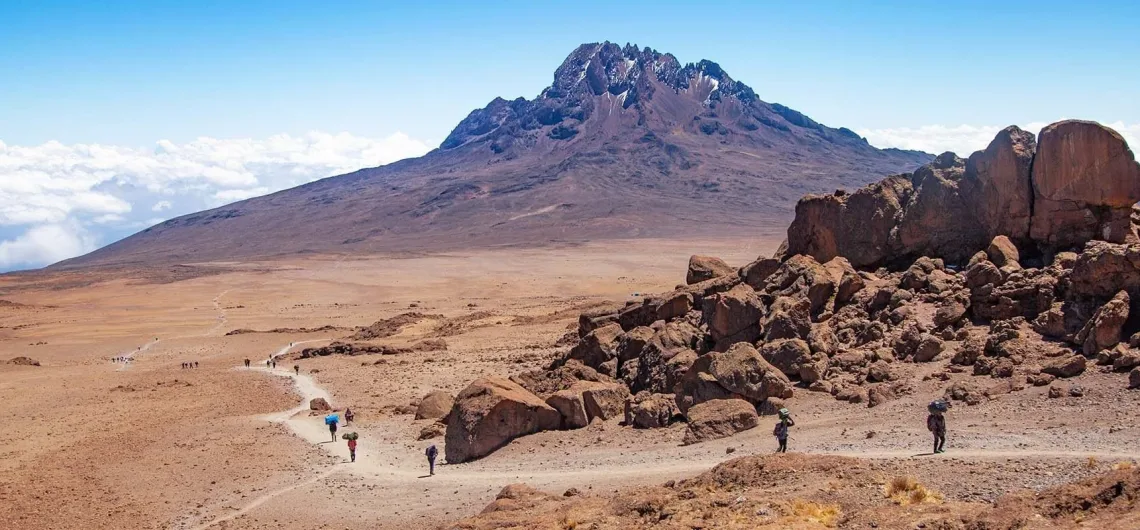
How do you climb Mount Kilimanjaro? What does it feel like? At Tranquil Kilimanjaro, it is a routine that follows strict schedules and practices after proper planning, of course. Climbing Mount Kilimanjaro is a powerful mix of awe, challenge, and pure triumph. It is not just a hike — it is a journey through five completely different worlds in just a few days, ending with one of the most emotional moments of your life.
From the plane or the plains below, Kilimanjaro looks enormous — a massive, snow-capped giant rising straight out of the African savanna. Many climbers feel a mix of excitement and nerves when they first see it. But once you start, that fear quickly turns into quiet determination as you begin walking slowly up the mountain.
Most days on the trail follow a simple but satisfying rhythm. You wake early to a hot breakfast prepared by the crew, then hike at a gentle “pole pole” pace for four to eight hours. In the afternoon, you arrive at camp to find your tent already set up, ready for a rest before enjoying a surprisingly good three-course dinner. The landscape changes dramatically as you climb higher. The lush rainforest of the lower slopes gives way to open heathland filled with strange lobelia plants, then to stark alpine desert that feels almost lunar, and finally to the icy summit zone.
- Before you begin your trek in Tanzania, please see how to plan and prepare.
- Here is everything you need to know, from how to apply for your visa to the vaccines required to enter Tanzania,
- If you haven’t chosen your route yet, learn with one that is the best for you.
- After choosing and comparing your routes, choose one here and book.
The support of your team makes a huge difference. Experienced guides, cooks, and porters work incredibly hard so you can focus on the climb. Many people say the camaraderie with fellow trekkers and the constant care from the crew become one of the highlights of the entire experience.
Summit night is the real test. You wake around midnight in freezing temperatures, layer up heavily, and begin the long, slow climb in the dark. It is cold, steep, and mentally tough, and it can feel like it will never end. But then the sky begins to lighten. You reach the crater rim just as the sun rises over the glaciers. One final short walk takes you to Uhuru Peak at 5,895 metres. Standing there, hugging the summit sign as the sun explodes on the horizon, brings an overwhelming rush of joy, relief, and pride that very few people ever forget.
How to Climb Mount Kilimanjaro: Step-by-Step Experience & Logistics
Climbing Kilimanjaro is physically and mentally demanding. You will be tired and pushed outside your comfort zone at times. Yet with the right route, proper acclimatisation, and a strong support team, most people succeed and return home with a deep sense of achievement. The reward is not only the incredible view from the top of Africa, but the personal growth and unforgettable memories created along the way. Let us walk you through exactly what happens from the moment you land in Tanzania until you head home or continue your adventure. Everything is based on standard professional operator practices for a safe, smooth experience.
1. Arrival at Kilimanjaro International Airport (JRO) & Transfer to Hotel
Most climbers fly into Kilimanjaro International Airport (JRO), the closest and most convenient airport.
- Your Tranquil Kilimanjaro driver or representative will meet you at arrivals (holding a sign with your name).
- They assist with luggage and handle any visa or customs questions.
- Private transfer to your hotel in Moshi (45–60 minutes) or Arusha (about 1 hour).
Recommended arrival timing: Arrive at least 1–2 days before your climb starts. This allows time to recover from jet lag, adjust to the altitude slightly, and attend the pre-trek briefing without rushing. You’ll stay in a comfortable hotel with hot showers, good food, and Wi-Fi. Your main luggage stays safely stored at the hotel while you climb.
2. Pre-Trek Briefing & Gear Check (Evening Before Departure)
This is one of the most important parts of your trip.
- Usually held at 6:00 PM the night before you leave for the mountain.
- Your lead guide (and sometimes the operations manager) meets you at the hotel.
- What happens:
- Full review of the itinerary and daily schedule.
- Safety briefing (altitude sickness symptoms, “pole pole” slow pace, hydration, etc.).
- Introduction to the climbing team (guides, assistant guides, cooks, porters).
- Thorough gear check — they inspect everything you brought and tell you exactly what to rent locally if needed (sleeping bag, trekking poles, warm jacket, etc.).
- Questions and answers session.
- Final packing advice (what goes in your daypack vs. the porter duffel).
Tip: Bring all your trekking gear to this meeting. It’s your last chance to fix any issues before heading to the mountain.
3. Departing for the Mountain & Gate Registration
Morning of departure (usually Day 1 of the climb):
- Early breakfast at the hotel (around 7:00–8:00 AM).
- Load your duffel bag (max weight usually 15–20 kg) into the vehicle.
- Drive to the trailhead gate (drive time: 1–3 hours depending on route — e.g., Machame Gate or Lemosho/Londorossi Gate).
At the Gate – Registration Process:
- Your guides handle most paperwork.
- You may be asked to sign the park register.
- Porters are weighed (strict limits to protect them).
- Park rangers check permits and sometimes do a quick group briefing.
- Photos at the official gate sign are common.
Once registration is complete, you start hiking into the rainforest!
4. Typical Day-to-Day on the Mountain
Most days follow a similar relaxing rhythm (except summit night):
Daily Routine:
- Wake-up: 5:30–6:30 AM (earlier on summit day).
- Breakfast: Hot porridge, eggs, toast, fruit, tea/coffee (surprisingly good food!).
- Pack daypack (water, snacks, rain jacket, warm layers, camera, headlamp, sunscreen).
- Porters pack and carry the main duffel + tents.
- Hiking: 4–8 hours per day at a slow “pole pole” pace.
- Lunch: Usually a hot meal or packed lunch on the trail.
- Afternoon arrival at camp: Mid-afternoon.
- Porters set up tents and prepare hot water for washing.
- Rest & acclimatization: Relax, read, take short walks around camp.
- Dinner: 3-course meal around 6:00–7:00 PM.
- Evening briefing for the next day.
- Early to bed (by 8:00–9:00 PM).
Summit Night (usually Day 6 or 7):
- Wake up around midnight or 1:00 AM.
- Light breakfast + hot drinks.
- Start hiking in the dark with headlamps.
- 6–8+ hours to Uhuru Peak.
- Short celebration at the summit, photos, then descend.
- Reach camp for late lunch and rest.
5. Descending the Mountain
Descent is much faster than the ascent (usually 1–2 days).
- You often descend via a different (or same) route.
- Hike down to the exit gate the same day you summit or the following morning.
- Porters carry all your gear down.
- You’ll feel much stronger as oxygen levels increase.
6. Picking Up Your Certificate & Returning to the Hotel
At Mweka Gate (most common exit gate for Machame, Lemosho, etc.):
- After reaching the gate, your guides take you to the ranger station.
- You receive your official Tanzania National Parks (TANAPA) summit certificate.
- Gold certificate if you reached Uhuru Peak.
- Group photos at the gate sign are popular.
Return to Hotel:
- Private transfer back to your Moshi or Arusha hotel (usually 1–2 hours).
- Hot shower, clean clothes, and a celebratory dinner.
- Many operators include a special “summit celebration” meal.
You’ll usually be back at the hotel the same afternoon or early evening of your descent day.
7. Departing Tanzania – Safari or Zanzibar Options
After the climb, you have excellent options to extend your trip:
Option 1: Tanzania Safari (Highly Recommended)
- Most people add a 4–6 day safari right after the climb.
- Popular route: Tarangire → Serengeti → Ngorongoro Crater (Big Five guaranteed in Ngorongoro).
- You’ll have at least 1 full rest day in the hotel before starting the safari (highly advised for recovery).
- Many climbers say the safari feels even more magical after the physical challenge of Kilimanjaro.
Option 2: Zanzibar Beach Extension
- Fly from JRO or Arusha to Zanzibar (short flight, ~1.5 hours).
- Perfect for recovery — white sand beaches, turquoise water, swimming, and relaxation.
- Many people do climb → 1 rest day → Zanzibar for 4–7 nights.
Option 3: Direct Departure Home
- Fly out of JRO the day after returning from the mountain (or after a rest day).
Sample Post-Climb Timeline (Popular Combination):
- Day 8/9: Descend + return to hotel + certificate
- Day 9/10: Rest day in Moshi/Arusha
- Day 10/11–14/15: 4–5 day Northern Tanzania Safari
- Day 15/16+: Fly to Zanzibar or home
Final Tips for a Smooth Experience
- Travel insurance must cover high-altitude trekking + emergency evacuation.
- Keep your passport and important documents in your daypack or with the guide.
- Tipping the mountain crew is customary (your guide will give you guidelines at the briefing).
- Stay hydrated and listen to your body throughout.
Ready to experience the full journey with Tranquil Kilimanjaro?
We handle every detail — airport pickup, pre-trek briefing, expert guides, safe logistics, certificate, and seamless extensions to safari or Zanzibar.
Frequently Asked Questions by Mountain Climbers
How long does it take to climb Mount Kilimanjaro?
Most climbs take between 6 and 9 days, including the ascent and descent. We strongly recommend 7 or 8-day itineraries (such as the Machame or Lemosho routes) because they allow better acclimatization and significantly increase your chances of reaching the summit safely.
What is the best time of year to climb Kilimanjaro?
The best months are January, February, July, August, September, and October. These periods offer the driest weather and clearest views. We can climb year-round, but the dry seasons provide the most comfortable and enjoyable conditions.
Which route is best for first-time climbers?
The Lemosho route (8 days) and Machame route (7 days) are our most popular choices for first-timers. Both offer excellent scenery, good acclimatization profiles, and high success rates. The Lemosho route is especially recommended because it starts on the quieter western side of the mountain.
How fit do I need to be?
You don’t need to be an elite athlete, but you should have a good level of cardiovascular fitness and endurance. Being able to hike for 6–8 hours with a daypack and walk uphill comfortably is ideal. We provide training guidelines to help you prepare.
What is the success rate of climbing Kilimanjaro?
Overall success rates average around 65–80%, but this rises dramatically to 85–95%+ on well-paced 7–9 day routes with proper acclimatization. Choosing the right itinerary and listening to your guides are the biggest factors in reaching the summit.
How much does it cost to climb Kilimanjaro?
A quality 7 or 8-day climb with Tranquil Kilimanjaro typically ranges from $2,800 to $4,500 per person (depending on group size and route). This includes park fees, professional guides, porters, meals, tents, and transfers. We offer both group and private departures.
What should I pack for climbing Kilimanjaro?
You’ll need a good layering system for changing temperatures, sturdy, broken-in hiking boots, a warm sleeping bag, trekking poles, and a headlamp. Many items (such as sleeping bags and warm jackets) can be rented locally in Tanzania. We provide a detailed packing list and conduct a full gear check before departure.
Is altitude sickness a big risk?
Altitude sickness is the main challenge on Kilimanjaro. However, the risk is greatly reduced by choosing longer routes, walking slowly (“pole pole”), staying well hydrated, and following your guide’s instructions. Our teams carry oxygen and conduct regular health checks throughout the climb.
What happens on summit night?
Summit night is the most demanding part of the climb. You usually start around midnight from the high camp and hike for 6–8 hours in the dark and cold to reach Uhuru Peak (5,895m). The reward is watching the sunrise from the roof of Africa — an unforgettable experience for most climbers.
Do I need travel insurance for climbing Kilimanjaro?
Yes. Your insurance must specifically cover high-altitude trekking up to 6,000m and include emergency medical evacuation (including helicopter rescue). We can recommend suitable policies if needed.
Can I combine my Kilimanjaro climb with a safari or Zanzibar?
Absolutely. Many of our clients add a 4–6 day Tanzania safari (Tarangire, Serengeti & Ngorongoro) or a relaxing beach extension in Zanzibar after their climb. We can arrange seamless packages that include transfers and accommodations.
When should I arrive in Tanzania before my climb?
We recommend arriving at least one or two days before your climb starts. This gives you time to recover from travel, attend the pre-trek briefing and gear check, and rest before heading to the mountain.
Contact us today for a personalized itinerary that includes your arrival-to-departure plan. Would you like us to create a full sample 10–16-day itinerary combining Kilimanjaro + Safari + Zanzibar? Just let us know your preferred dates and group size!