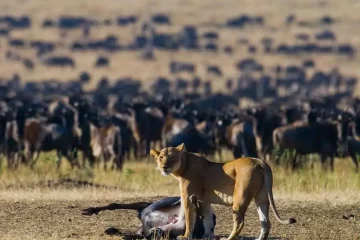
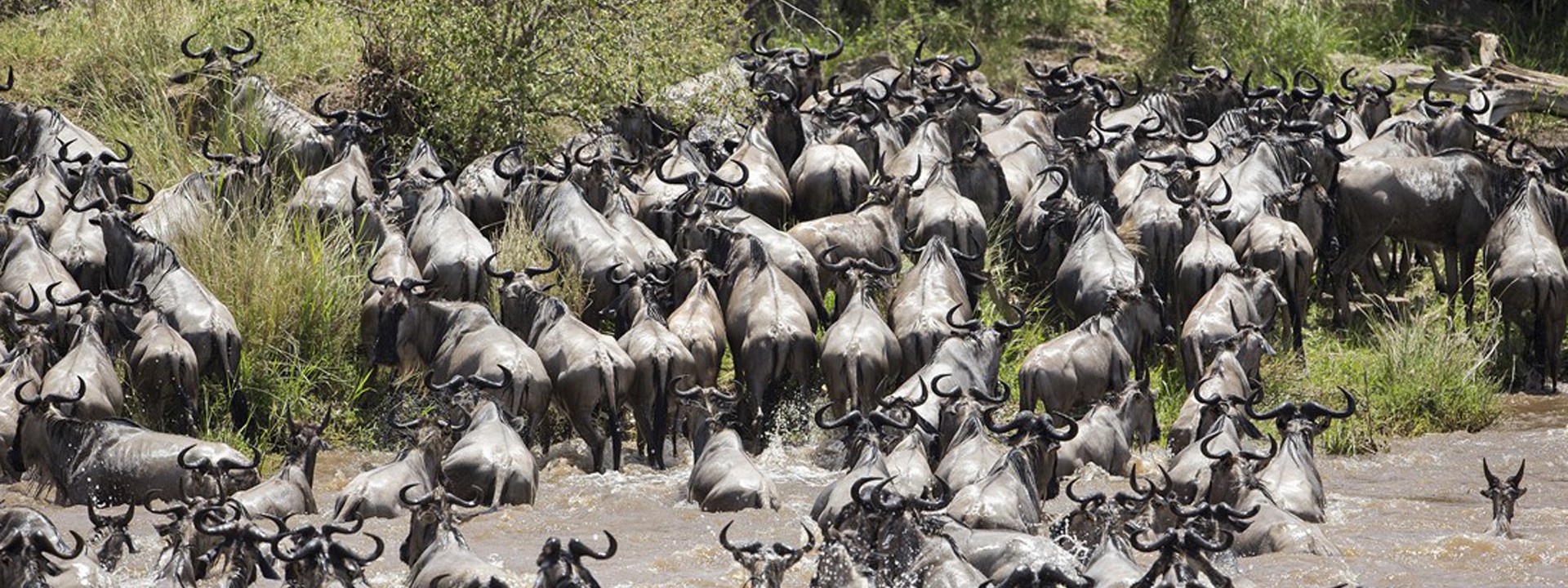
The Great Wildebeest Migration is a crowd puller. Not just the wildebeests themselves, but also huge numbers of other wild animals are escorting them. Wherever you see herds of wildebeests, be sure to see herds of zebras and all forms of antelope species. Now here is where it gets interesting, all these numbers of wildlife trying to cross over to the other side of the river for greener pastures have a high density of grazers and browsers, all prey. That is why even predators gather here to hunt as much food as possible before they leave for the other side of crocodile infested river. Whether they are crossing from Tanzania’s Serengeti to masai Mara in Kenya or the other way round, dramatic events of hunting and stalking must ensue. In the midst of all this drama, expect to see lions, cheetahs, leopards, wild dogs, crocodiles, hyenas, jackals, vultures and all the other predators and scavengers to take part in this dramatic gathering. It starts with a faint rumble you feel in your chest before your ears catch up – that deep, rolling thunder of countless hooves hammering the dry earth. Long before the first dark shapes crest the horizon, you know the wildebeest are on the move again. These scruffy, bearded creatures with their awkward sloping backs and curved horns don’t look built for epic adventures, yet every year they pull off one of the last truly wild journeys left on the planet, looping clockwise across the endless plains that straddle Tanzania’s Serengeti and Kenya’s Maasai Mara.

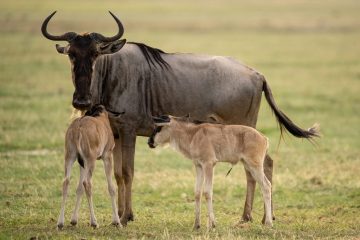
Rain runs the whole show, and it answers to no timetable. The herds simply follow wherever fresh, sweet grass sprouts after the showers pass through. Down in the southern short-grass flats around Ndutu, the early-year downpours spark the calving frenzy. In just a few frantic weeks, hundreds of thousands of calves hit the ground – wobbly, wide-eyed little things that find their legs in minutes and start keeping pace with the adults. It’s survival math at its rawest: flood the plains with new life so the lions and hyenas can’t take them all.

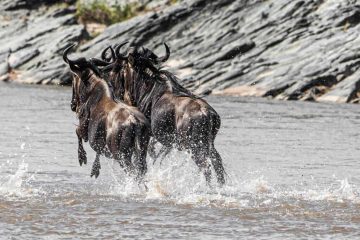
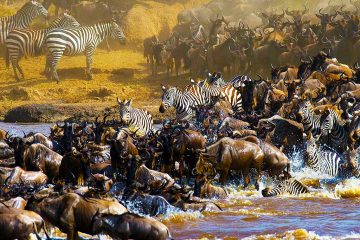
Then the grass thins, the wind shifts, and the great northward drift begins. The animals stretch into long, dusty columns that snake for miles, kicking up hazy red veils you can see from a distance. They weave through the central Serengeti, some peeling off to test the Grumeti River’s crocodile-heavy waters. But the real gut-punch comes farther north along the Mara. Herds bunch up on the steep banks for days sometimes, grunting and jostling, testing the air. Then – no warning, no leader, just one animal deciding – the whole mass surges. Bodies pour down the crumbling dirt, hooves churning the water to white foam, crocodiles exploding upward while cats wait in the tall grass on the far side. The lucky ones scramble out, dripping and dazed onto greener pastures; the rest become part of the river’s story.

Later, when the short rains whisper from the south again, the whole tide turns. Back they drift through the central expanses, spreading out, their hooves grinding nutrients into the soil and keeping the savanna open for everything smaller that follows. By year’s end, they’re looping home, ready for the next round of roughly a thousand kilometres.What stays with you isn’t always the famous river chaos. It’s the everyday scale – plains that feel alive for months on end, that constant low rumble in the distance, the way predators shadow the edges like patient ghosts. In a world where so many wild paths have been cut off by fences and farms, this migration still runs free, answering only to the sky and some deep, stubborn instinct. Stand in its path once, and you feel properly small, in the best possible way.

The Great Wildebeest Migration is a once-in-a-lifetime safari adventure that will leave you with memories to cherish forever. It is an extraordinary opportunity to witness the wonders of nature, the cycle of life, and the raw beauty of the African savannah.
Wildebeest Migration Safari Itineraries

Wildbeest migration safari, Kilimanjaro and Zanzibar

16 Days Wildebeest migration safari, Kilimanjaro trek and Zanzibar

A 16-day wildebeest tracking, Kilimanjaro trekking and a relaxing beach adventure through Tanzania's most iconic landscapes and most amazing adventures.
Wildebeest calving safari

6 Day Wildebeest Calving season & Migration Safari in Ndutu - Serengeti

This life-touching 6-day wildebeest calving season safari gives you an insight into the life cycle of the wildebeests of Africa
7 days great wildebeest migration safari

7-Day Great Wildebeest Migration Safari in the Western & Central Serengeti

An unforgettable 7-day great wildebeest adventure across the Western Corridor, Grumeti, and Mbalageti to Central Serengeti through Tanzania's wilderness with
wildebeest with calves twins

8 Days Ndutu - Wildebeest Calving Season Safari

The 8 day Ndutu Exclusive Calving safari is 100% proof that there is never a dull day at the Ndutu
great wildebeest crossing

10 days Mara river crossing & Great Wildebeest migration, Serengeti safari

This epic 10-day safari of the wildebeest crossing across the Mara River from Tanzania's Serengeti National Park into the Masai

When Is the Best Time for a Wildebeest Migration Safari?

There’s no single perfect month – and honestly, that’s half the thrill. The “best” time boils down to which chapter of this endless, rain-chased drama you’re itching to see. The Serengeti and Maasai Mara stay magical year-round anyway, packed with wildlife even when the main herds have wandered off. Click here to see our month to month guide of this all year round spectale.

The migration seasons

The great wildebeest migration is an all-season event that occurs in stages. It is a never-ending natural phenomenon that is broken down in a seasonal loop. If you’re chasing the big moments, here’s how the story usually unfolds.

Calving Season
February to March (sometimes kicking off in late January)
Southern Serengeti, around Ndutu

This is pure life exploding on the short-grass plains. Half a million tiny hooves hit the ground in a matter of weeks – wobbly calves finding their legs while lions, hyenas and cheetahs prowl the edges like it’s an all-you-can-eat buffet. The air feels electric with new beginnings and raw survival.

Rutting (Breeding) Season
April to May
Western and central Serengeti

The males turn into loud, testosterone-fueled wrecking balls, grunting and sparring nonstop. The herds are on the move again, columns stretching for miles as they push north through fresh green that follows the rains.

Grumeti River Crossings
May to June
Western Serengeti

The first real test. The animals bunch up at the water’s edge, nervous energy crackling, while crocodiles wait below like patient logs with teeth. Fewer crowds than the Mara, but the tension is every bit as thick.

Mara River Crossings
July to August (sometimes spilling into September)
Northern Serengeti and Maasai Mara

This is the one that stops your heart. Thousands of wildebeest and zebra teeter on steep banks, then suddenly pour down in a dusty avalanche, churning the brown water white while crocs lunge and big cats crouch in the grass on the far side. Pure chaos and courage in equal measure.

Heading South Again
November to January
From the Maasai Mara back toward the southern Serengeti

The short rains pull the herds homeward in a more scattered, steady drift across the open plains. It feels quieter, almost reflective – the great loop quietly restarting under wide skies.

Helpful tip from watching this cycle for years: The bulk of the action stays inside the Serengeti most of the time. It’s one continuous circle, not a single event – there’s always something happening somewhere. River crossings laugh at calendars; the herds might loiter on the bank for two weeks straight or fling themselves across four times in a single afternoon. The animals are never in one neat clump – there are always scouts way out front and stragglers far behind. If you’re dead-set on a crossing (especially for photos), plan to park yourself at a likely spot all day. Midday light can be brutal, but that’s often when the drama peaks. The secret isn’t pinning down an exact date on the calendar. It’s choosing the chapter that fires you up and building a flexible trip around it so you’re in the right corner of this vast wilderness when the moment arrives.

Where Should You Stay for a Wildebeest Migration Safari?

Your choice of base camp can quietly steal the show – or quietly ruin it. Some travellers want to wake up with the herds literally rumbling past their tent zip, while others prefer a hot shower and a cold drink waiting when they roll back dusty and exhausted. That’s why the options split cleanly into two camps: mobile setups that chase the action, and permanent lodges that stay put in the right neighbourhoods.

Mobile Migration Camps

These are the nomads popularly known as migration camps. Some actually fold up and move with the wildebeest every few weeks; others reposition seasonally so you’re always parked near the next big chapter. You get proper canvas tents with real beds and en-suite bathrooms, but the showers are the classic bucket kind (pull the rope, water cascades), basins might be filled from jugs, and running water isn’t guaranteed. Power comes from solar panels or a humming generator. Charging points are usually communal. The payoff? You fall asleep to the low grunting of thousands of animals and open your eyes to fresh hoof prints right outside your door. It feels properly wild, like you’re part of the migration instead of just watching it.

Permanent Lodges

These are the solid anchors. Fixed in carefully chosen spots, they give you hot-and-cold running water on tap, proper showers (sometimes open to the stars), flush toilets, and often a bathtub or outdoor option with a view of giraffes drifting past. Electricity flows reliably, Wi-Fi usually works, and you can plug your camera in without queuing. They feel like a luxurious home base after long days on the plains – think decks overlooking the savanna, cold beers at sunset, and the knowledge that the herds are never more than a game drive away.

How Does the Great Wildebeest Migration Occur?

It’s not some tidy parade that fires up in July and shuts down in October. The Great Migration is a restless, year-round clockwise loop of roughly two million animals – mostly those scruffy, bearded wildebeest, trailed by big herds of zebra and a scatter of gazelle – endlessly circling the huge Serengeti-Mara ecosystem that sprawls across Tanzania and Kenya.

Where does the wildebeest migration begin?

The whole thing is steered by nothing more glamorous than rain and the fresh grass that explodes wherever it falls. The herds simply drift after the showers, following an ancient instinct as old as the plains themselves. They’ll graze their way south first, hitting the short-grass flats near Ndutu and the edge of the Ngorongoro Crater when the calving season kicks in. As that grass thins, the long columns swing west and north through the central Serengeti, testing the Grumeti River, then pushing on into the Maasai Mara when the northern pastures hit their prime. Later, when the short rains whisper back south, the great tide slowly turns and they begin the long drift home again.

Can those death-defying river crossings actually be predicted?

Not a chance. Not by the sharpest guides, not by the scientists, and apparently not even by the wildebeest. Some herds roll up to the water’s edge, take one look, and pour straight across in a dusty avalanche. Others will camp out on the bank for days, grazing and grunting while they work up their nerve. And sometimes a whole group just shrugs, turns around, and heads back the way they came. That total unpredictability is exactly why more days in the bush give you a far better shot at catching one of those heart-in-your-throat moments.

So when do the wildebeest actually migrate?

Most people picture July to October because that’s when the famous Mara River crossings happen, and the parks are packed with visitors. In reality, the migration never stops. Different chapters unfold every single month – the wild calving explosion down south, the noisy rutting battles further west, the tense Grumeti crossings, the big Mara drama, and the quieter return drift when the rains pull everyone home. It’s one continuous, living circle.

Why do the wildebeest risk migrate between Serengeti and Masai mara

At its core, it’s pure survival. The animals are chasing fresh, sweet grazing and water to stay alive even when going the extra mile to evade predators on land like lions, and in water like the crocodiles. Some old hands swear distant lightning and thunder act like a magnet, tugging the herds onward, but there’s no hard proof – the rain and the grass are definitely the real bosses. It’s raw, unpredictable, and completely untamed. And once you’ve stood out there with the rumble vibrating through your boots, you understand why this endless loop still feels like one of the last true wild things left on the planet.

Important Tips for booking your wildebeest migration safari

Book the moment you decide to go. These places are tiny and vanish fast – especially for the river-crossing months. Start at least a year ahead if you’re aiming for June to October.

Timing is important, the earlier, the better!

High season (especially June–October) fills up fast. The river crossings are the hottest ticket, but you can catch the herds any month if you’re flexible.

Match your dates to the story you want to see

Calving in the south, rutting in the west, Grumeti or Mara crossings, or the quiet return south – time it right and the migration feels personal instead of random.

Avoid the crowds

The main reserves get busy when the herds do. Private conservancies bordering the Maasai Mara give you exclusive land, night drives, walking safaris, and off-road freedom that the national park doesn’t allow. In the Serengeti, some brilliant camps sit just off the main migration highway – you reach the drama in minutes but retreat to silence when you need it. (Northern Serengeti around Kogatende often feels less packed than the Mara side.)

Don’t let the migration take over everything

Days surrounded by dust, noise, and endless wildebeest can get intense. Finish your trip at a quieter lodge somewhere else in the Serengeti or Mara so you can enjoy classic Big Five sightings and a bit of breathing room.

Add variety

The Mara and Serengeti slot perfectly into longer journeys. Pair the Mara with Amboseli and Laikipia, or add the Ngorongoro Crater, Tarangire, and the Rift Valley lakes to a Serengeti core. You can even stretch it to Mount Kilimanjaro, Mount Meru, a gorilla trek in Rwanda, or a few beach days in Zanzibar.

The best trips never feel like a package – they feel like your own story unfolding across the plains. Ready for a few sample itineraries that actually work? Just say the word and I’ll sketch some real ones around your dates and budget.

A Month-by-Month Guide of the Great Wildebeest Migration

Climate change has quietly rewritten the rules. The long rains and short rains that once marched in like clockwork now show up early, late, or sometimes not at all. The wildebeest don’t argue with the weather – they just keep moving. That’s why the smartest trips build in plenty of breathing room. You can’t parachute in for a couple of nights hoping to tick off a river crossing; nature plays the long game here. Here’s how the great clockwise loop usually unfolds, month by month. These are rough signposts, not guarantees – the rain still calls every shot.

January

The herds are easing south from the north-eastern Serengeti, spreading out toward the short-grass plains around Lake Ndutu. Two million animals in total, but never one single stampede. You’ll see loose groups of hundreds or thousands drifting wherever yesterday’s shower left a green flush. The unfenced landscape lets them roam exactly where instinct pulls them.

February to March

Calving season explodes across those southern plains – up to eight thousand tiny wildebeest hit the ground every single day. One minute a mother is grazing, the next there’s a wet, wobbly calf struggling to stand. It’s breathtaking and brutal all at once: lions, hyenas, jackals and wild dogs turn the plains into a living theatre of life and death. If the short rains delivered decent grazing, the herds linger here feeding hard before the slow westward drift begins.

April

The long rains arrive and the mood shifts. Herds start pushing northwest toward the granite boulders of Moru and Simba Kopjes. Rutting is in full swing – males are loud, dusty and full of attitude, locking horns and chasing anything in heat. The plains rumble with testosterone and thunder.

May

Wagons roll for real. The columns stretch for forty kilometres or more as the now-stronger calves keep pace. The central Serengeti becomes a moving river of hooves and dust. Everyone’s travelling a little faster now that the easy southern grass is behind them.

June

The herds bunch in the central Serengeti, gathering nerve for the toughest leg. Some groups have already tested the Grumeti River; others are still grazing and waiting for their moment. The tension starts to build.

July

They reach the Grumeti region and northern Serengeti, staring across the Mara River like it’s a dare. Nile crocodiles the size of small cars lie just under the surface – that’s the reason for all the hesitation. Crossings remain completely unpredictable; some herds charge straight in, others camp on the bank for days or turn around entirely. Book early, stay close to the river (or choose a mobile camp that follows the action), and be ready to wait. Patience is the only ticket that works.

August

This is the heart-stopping month most people picture when they say “Migration.” The big Mara River crossings are at their wildest. You’ll need a passport to cross into Kenya; the wildebeest simply swim. For a quieter, more intimate experience, head into the private conservancies bordering the Maasai Mara instead of the public reserve – same drama, fewer vehicles, and a completely different feel.

September

The giant herds start to splinter. Fewer than half remain in the northern Serengeti; the rest are scattered across the Mara, swapping war stories. September still belongs to the Kenyan side for the best concentrations, but you can still find smaller groups back in Tanzania if you’re in the right corner.

October

The Mara is still the place to be, but the national reserve can feel busy. The private conservancies win again here: wide-open space, direct support for the Maasai communities who’ve lived on this land for centuries, and the freedom to do night drives, walking safaris and off-road tracking that the main park doesn’t allow.

November

The short rains finally stir and the herds turn south again, leaving the grazed-out Mara grasslands behind. They move through the north-eastern Serengeti, splitting into smaller bands as they head toward fresh green. Timing depends entirely on when those rains decide to fall.

December

The southern pull strengthens. Wildebeest stream across the northern and eastern Serengeti, feasting on new shoots and quietly rebuilding strength for the next full loop – another three-thousand-kilometre journey that never really stops. Quick practical note for the wetter months: Africa isn’t always hot when it rains. Early mornings and late afternoons can turn chilly and muddy. Bring trousers, proper closed shoes, and at least one warm or waterproof layer. You’ll thank yourself on those long game drives.

The beauty is that the migration is never “off.” Different chapters play out every single month – you just have to show up with open eyes and enough time to let the plains write the story.