
You are well aware that you cannot climb Mount Kilimanjaro without a guide and the mountain guide must be a lincenced one. Having a guide is very important, no matter the numbe of climbers in a party. Yes even solo climbers will need a guide. The role of guide is to cordinate, lead, and make important decisions incase of anything. On a standard Kilimanjaro climb, the number of guides depends on your group size, but here’s what you can typically expect with a reputable operator like Tranquil Kilimanjaro:
Typical Guide-to-Climber Ratio
- Small groups (2–4 climbers): Usually 1 Lead Guide + 1 Assistant Guide.
- Medium groups (5–8 climbers): 1 Lead Guide + 1–2 Assistant Guides.
- Larger groups (9+ climbers): 1 Lead Guide + 2+ Assistant Guides.
Most good operators follow a 1 guide per 2–3 climbers ratio for safety and good service. This is higher than the legal minimum (which is roughly 1 guide per 2 climbers on some routes).
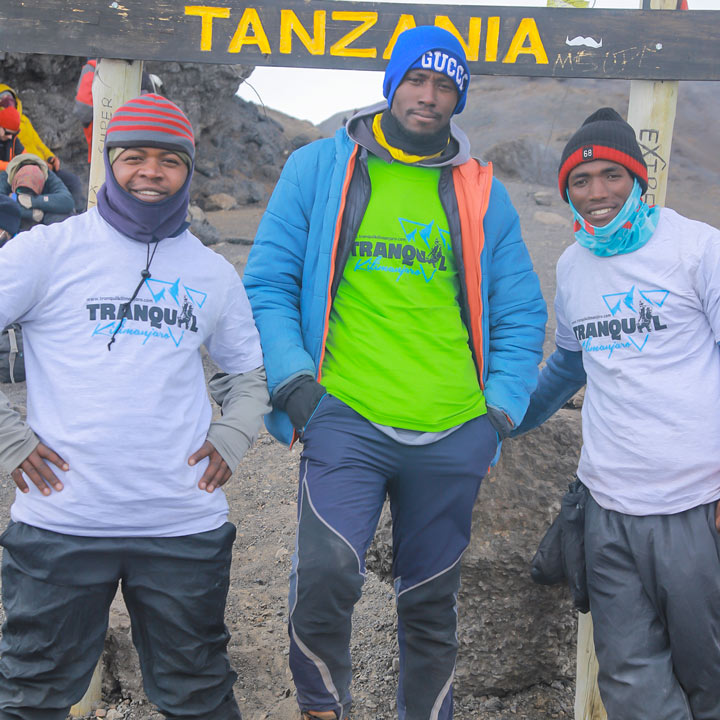
Roles of the Mountain Guides
- Lead Guide — Overall leader, very experienced, makes decisions on pacing, health, and summit attempts. Usually speaks excellent English.
- Assistant Guides — Help with daily operations, carry some emergency gear, monitor clients, and support slower climbers. They often rotate duties.
Why This Matters
- Good guide support dramatically improves your safety and summit success rate.
- Guides monitor altitude sickness daily, set a safe “pole pole” (slowly) pace, and help with everything from motivation on summit night to emergency situations.
Read more about Tranquil Kilimanjaro guides
The crew size depends on your group size and the route length, but here are realistic examples for common scenarios:
1. Small Group (2–4 Climbers) – Most Common
- Guides: 1 Lead Guide + 1 Assistant Guide
- Cook: 1 Cook
- Porters: 6–10 Porters (usually 2–3 porters per climber)
- Total Crew: Approximately 8–14 people
2. Medium Group (5–8 Climbers)
- Guides: 1 Lead Guide + 1–2 Assistant Guides
- Cook: 1 Cook (sometimes + assistant)
- Porters: 12–20 Porters
- Total Crew: Approximately 15–25 people
3. Larger Group (9–12+ Climbers)
- Guides: 1 Lead Guide + 2+ Assistant Guides
- Cook: 1 Cook + Assistant Cook
- Porters: 20–30+ Porters
- Total Crew: Can easily exceed 30 people
Roles of Each Team Member
| Role | Number (Typical) | Responsibilities |
|---|---|---|
| Lead Guide | 1 | Overall leader, safety, pacing, health monitoring, summit decisions |
| Assistant Guides | 1–3 | Support clients, carry emergency gear, help slower climbers |
| Cook | 1 (sometimes + assistant) | Prepares all meals, manages kitchen tent |
| Porters | Varies (2–4 per climber) | Carry tents, food, water, your main duffel bag, set up camp, fetch water |
Why So Many People?
- Everything (tents, food, water, cooking gear) must be carried up and down the mountain.
- Porters are limited to 20–25 kg each (ethical standard) — this is why more porters are needed.
- The team ensures you only carry a light daypack (water, rain gear, layers, snacks).

