
There are a few firms that provide emergency helicopter evacuation services, although they may not be accessible at all times. Kilimanjaro SAR (Search And Rescue) has been the finest business since it is based in Moshi and can respond quickly; however, they have been temporarily unavailable since 2020. AMREF is another well-known helicopter evacuation service. However, because AMREF is located in Nairobi, its helicopters might take a long time to reach Kilimanjaro. As a result, AMREF collaborated with SAR to provide quicker service.
While helicopter evacuation services have been shown to be extremely essential and potentially life-saving, you should be aware that helicopters are not always available. Helicopters may be too busy with other emergencies or too far away to arrive on time; they can only land at designated helipads, so you’ll need to get to those landing points first; and helicopter evacuation service is not available at night or during inclement weather because it’s too dangerous for helicopters to fly and land. Finally, when arranging your climb and travel insurance, double-check that you’ll be insured for helicopter emergency evacuation.
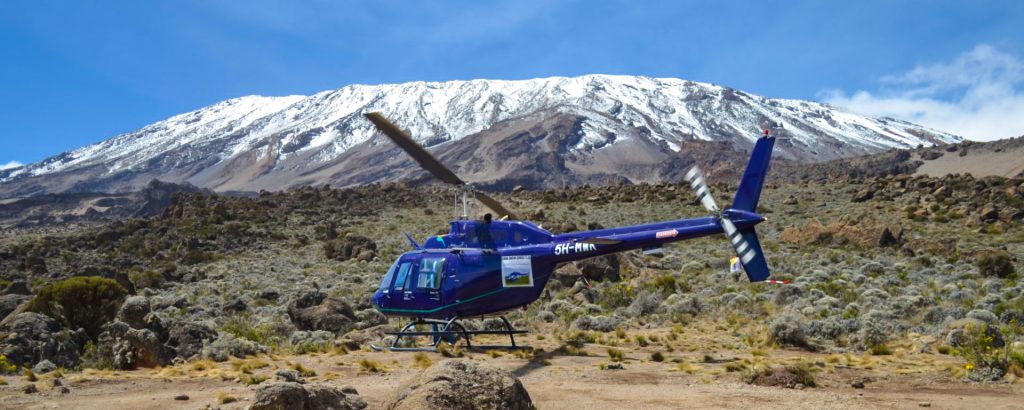
How It Works
- Primary provider: Companies like KiliMedAir or Kilimanjaro SAR (Search and Rescue) operate high-altitude helicopters based near Moshi. They can respond relatively quickly (often within minutes to hours once activated) for serious medical emergencies.
- Activation: Your guide/operator coordinates via radio/satellite phone. Ground teams may first stabilize you and move you (by foot or stretcher) to a suitable landing zone.
- Landing points: Not everywhere on the mountain. Key spots include lower camps and higher areas like Kosovo Hut (~4,900 m). You may need to descend from the summit area (e.g., Barafu) to a helipad.
Important Limitations
- Weather-dependent: Strong winds, fog, or storms can prevent flights, especially at higher altitudes. In those cases, stretcher/ground evacuation is used.
- Not for minor issues: Reserved for life-threatening situations (severe altitude sickness, injury, etc.). Minor problems mean walking down.
- Insurance required: Almost all reputable operators and services require proof of insurance covering high-altitude (up to 6,000 m) emergency evacuation. Without it, you pay out-of-pocket upfront.
Cost
- With valid insurance — Usually fully covered (after any deductible).
- Without insurance — $3,000–$10,000+ USD, depending on altitude, flight time, and medical needs. Hospital care adds more.
What This Means for You
- Choose an operator with a good relationship to a helicopter service and strong safety protocols (oxygen, monitoring, experienced guides).
- Mandatory travel insurance is non-negotiable—get a policy explicitly covering trekking at altitude and evacuation (e.g., up to 6,000 m). Many standard policies do not cover this.
- Prevention is best: Proper acclimatization (7–9 day routes), hydration, slow pace (“pole pole”), and listening to your body reduce the need for rescue.
Will I be covered for emergency helicopter evacuation on Kilimanjaro?
Helicopter rescue adds a valuable safety net, but it’s not foolproof. Focus on preparation to minimize risks. If your operator mentions their evacuation partner (e.g., KiliMedAir), that’s a good sign. Safe climbing!

