
If it is your first time climbing Mount Kilimanjaro and you do not have enough high-altitude climbing experience, we recommend the 8-day Lemosho Route (well-balanced) or the 9-day Northern Circuit Route (longer and a higher chance of summiting). These are among the longest routes to the summit of Kilimanjaro. The main reason why these longer routes are well-suited for beginners is that, since you spend more days on the mountain, you get the chance to familiarise yourself with the mountain conditions and get enough time to acclimatise properly. Instead of just climbing straight away, you will have enough time to climb high and sleep low, thanks to the extra acclimatisation days. The other reason is that, since you have more days on the mountain, the daily trekking distance is broken down into manageable time frames, rather than rushing and skipping some camps for overnight stays.
Many times when I pick up climbers at the airport, most of them have no mountaineering experience, and others have never climbed a high-altitude mountain, even half the height of Mount Kilimanjaro. High-altitude mountaineering begins between 2,500m and 3,500m (8,200–11,500ft) above sea level, where altitude sickness symptoms may begin to appear. From previous interactions with many beginners, I discovered that they mostly come from countries with few or no highlands or mountains, such as the Netherlands, Denmark, Estonia, Ireland, Cyprus, Australia, Latvia, Finland, the United Arab Emirates, Hungary, Paraguay, and Poland.
Let us not confuse first-time Mount Kilimanjaro climbers with first-time high-altitude climbers. It may be your first time climbing Kilimanjaro, but you may have climbed other mountains like Everest Base Camp, Aconcagua, Mont Blanc, Denali, Rainier, Mt Rainierthe Alps, Elbrus, the Dolomites and other high mountains. This guide is for climbers with little or no mountain climbing experience. If you have previous climbing experience, you can just browse any route that fits your budget and schedule here.
The main reason even first-timers can climb Kilimanjaro is that it is a non-technical trek and most of it is walkable. However, altitude sickness is the biggest obstacle, not steepness or technical climbing. Beginners succeed far more often on longer routes that allow gradual acclimatisation (“climb high, sleep low”). Shorter, rushed itineraries like the 5-day Marangu Route and 6-day Machame Route dramatically cut your chances, even if they feel “easier” on paper. Let me explain why we strongly recommend the 8-day Lemosho Route itinerary for first-time climbers.
Other Important Tips for First-Timers
- Go 7+ days — every extra day dramatically boosts your odds.
- Best seasons: January–March or June–October (driest).
- Preparation: Train cardio and legs for 3–6 months, practice hiking with a daypack. Climb Mt Meru (4,562m) beforehand if possible for extra acclimatisation.
- Fitness level needed: Good cardiovascular health and moderate hiking experience. No technical skills required.
Why Lemosho (8 days) Wins for First-Timers
If this is your first time on Kilimanjaro, book the 8-day Lemosho Route here. It gives you the perfect balance of safety, scenery, and summit success — exactly what most first-timers dream of.
- Superior acclimatisation: Starts on the remote western side, crosses the beautiful Shira Plateau, and gives you the classic “climb high, sleep low” profile. You gain altitude slowly (average ~530m per day).
- Stunning scenery: Rainforest → moorland → alpine desert → glaciers. You’ll see more ecosystems than on any other route.
- High success rate: 90–92% on the 8-day version — among the very best for non-professional climbers.
- Fewer early crowds: The first few days feel remote and peaceful before joining the busier upper sections.
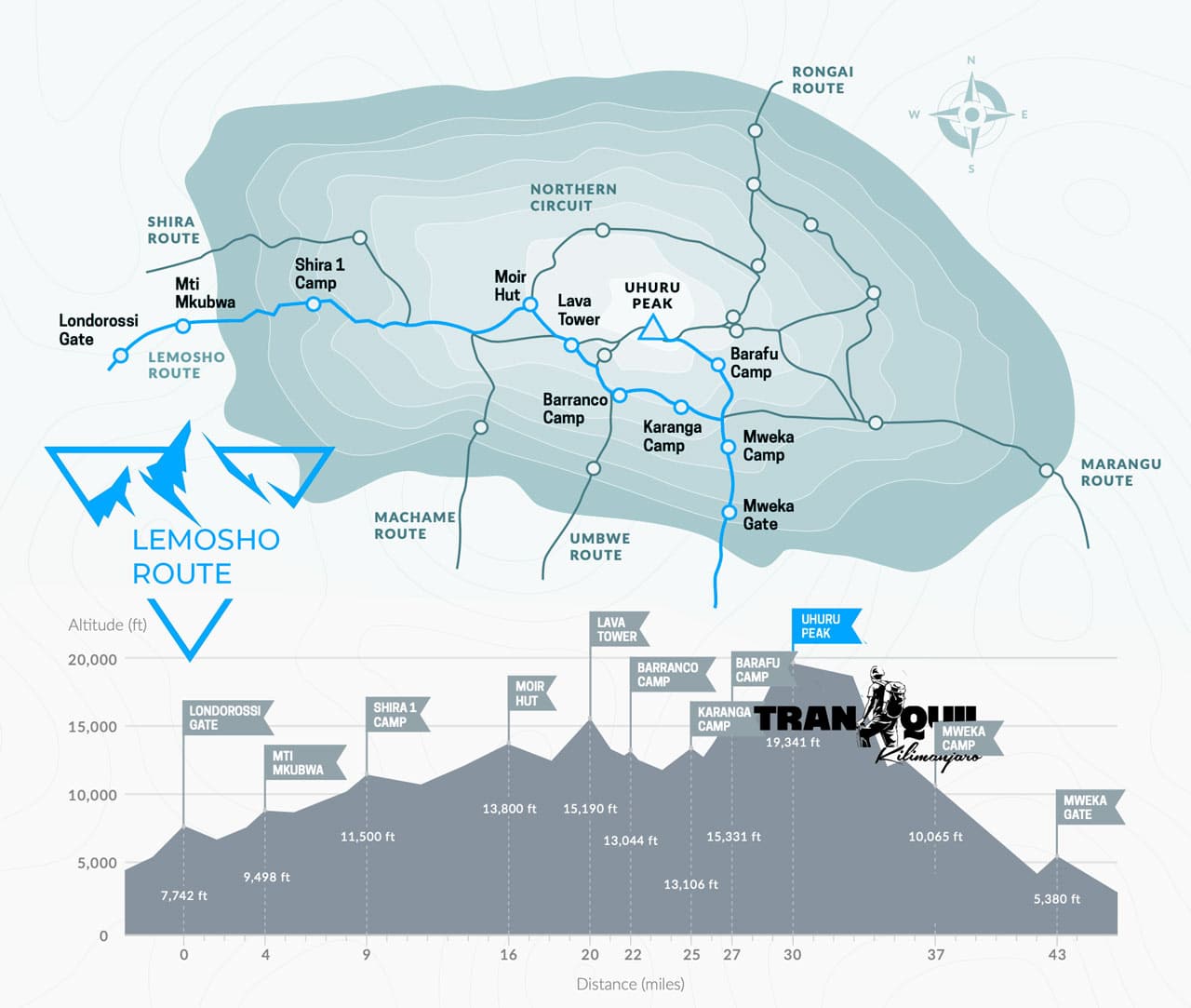
If you are on a strict budget or do not prefer hiking alone, you can join our group Lemosho Route trek with guaranteed departure dates here.
Strong Alternatives
Below are better than the rest of the routes, other than the 8-day Lemosho Route. Remember, each route has a shorter variant, suited for the experienced climbers. You can also choose these routes depending on your budget and the time you have available.
- Northern Circuit (9 days) — the absolute highest success rate (up to 95%). It circles the mountain for incredible 360° views and extra recovery time. Worth the extra day if your budget and schedule allow. Book the 9-day Northern Circuit Route
- Rongai (7 days) — if you want peace and quiet. Approaches from the drier northern side (Kenya border), fewer trekkers, gentler gradient. Book the 7 day Rongai Route.
- 6 Days Marangu Route – Great route if you are not a fan of camping. With the 6-day Marangu Route, you will not use tents but sleep in A-shaped huts, plus it has an extra day for acclimatisation. Book the 6 Day Marangu Route
- Machame (7 days) — the “Whiskey Route.” Almost as good for acclimatisation and scenery, slightly shorter and cheaper. The famous Barranco Wall section is dramatic but safe with guides. Book the Machame 7 Days Route
Let us know if you also want to join a group for climbing Kilimanjaro as a solo first timer, or if you feel you are one of the few people who need company on the mountain with like-minded climbers.
Kilimanjaro Routes Beginners Should Avoid:
If you’re a first-timer tackling Mount Kilimanjaro, the biggest mistake you can make is choosing a route that rushes your acclimatisation. Altitude sickness doesn’t care about your fitness level — it cares about how slowly you gain elevation. The three routes below are the ones we strongly advise first-timers to skip, even though they sound tempting (shorter, sometimes cheaper, or “more direct”). Here’s why each one is a bad idea for beginners, backed by real success rates and climber feedback.
1.6-Day Umbwe Route – The Steepest & Riskiest
Often called the “hardest route on Kilimanjaro,” Umbwe attacks the mountain head-on from the south with an incredibly direct, near-vertical climb through forest and rocky ridges.
Why avoid it as a beginner:
- Extremely steep from Day 1 — no gentle warm-up.
- Almost zero acclimatisation days (you rocket up too fast).
- The highest risk of severe altitude sickness and exhaustion.
- Success rate on the 6-day version: 50–60% (some operators report as low as 44%). Even the 7-day version only reaches ~70%.
- Very few climbers (only ~500 per year) and almost no beginners succeed without prior high-altitude experience.
It’s a route for very fit, experienced mountaineers who want a challenge like trail runners — not your first Kilimanjaro attempt.
2. Shira Route (Usually 7 Days) – Starts Too High, Too Fast
The Shira Route (sometimes marketed as a shorter version of Lemosho) drives you by vehicle straight onto the Shira Plateau at 3,500–3,850 m on Day 1.
Why avoid it as a beginner:
- You begin at high altitude with no gradual climb from the forest zone.
- Your body has zero time to adapt — AMS (acute mountain sickness) hits hard and early.
- Success rate: 60–80% (noticeably lower than Lemosho’s 85–95% on the same western side).
- Feels “easy” on paper because the first day is a drive, but that shortcut backfires for newcomers.
Lemosho does almost the exact same scenic path as the Shira Route, but starts lower and adds crucial extra days — that’s why it’s the beginner favourite.
3. 6-Day Machame Route – Scenic but Rushed
The famous “Whiskey Route” is beautiful and has great “climb high, sleep low” sections… when you do the 7-day version. The 6-day itinerary compresses everything and turns a manageable trek into a sufferfest.
Why avoid the 6-day version as a beginner:
- Day 4 becomes a brutal “double day” (long climb + descent with no proper rest at Karanga Camp).
- Success rate drops dramatically: ~73–75% (sometimes reported as low as 44% in older stats) vs 85%+ on the 7-day Machame.
- The extra 20% failure rate comes almost entirely from altitude issues caused by rushing.
Most operators now refuse to run the 6-day Machame for first-timers and strongly recommend adding that extra night.
Quick Comparison of the Main Routes for Beginners
Route | Days | Success Rate (approx.) | Difficulty for Beginners | Crowds | Best For | Accommodation |
|---|---|---|---|---|---|---|
7–8 | 85–92% (90%+ on 8 days) | Moderate (great acclimatisation) | Moderate | Scenery + highest realistic success | Tents | |
6–7 | 73–85% (7 days) | Moderate–challenging | High | Scenic variety & shorter time | Tents | |
6–7 | 70–85% | Easy–moderate | Low | Quiet northern side | Tents | |
8–9 | 85–95% | Easiest overall | Low | Maximum success & 360° views | Tents | |
5–6 | 27–60% | Physically easiest | Very high | Huts & shortest trip | Huts |
Your success depends on your route choice
These three mountain trails tempt you with shorter timelines and lower prices, but they quietly destroy your chances of summiting. Every extra day you add (7–9 days total) can boost your success rate by 15–30%. Stick to the proven winners: 8-day Lemosho or 9-day Northern Circuit. They give you the scenery, the safety margin, and the highest realistic odds (90%+) of standing on Uhuru Peak. You only get one shot at Kilimanjaro for many people — don’t gamble it on a route that’s designed for speed instead of success. Pole pole (slowly slowly) really does win the race here. If you want more information about all the routes on Kilimanjaro, please see the comparisons here.
Related: 7 Day Kilimanjaro Treks: The Best 1 Week Routes for Success

