
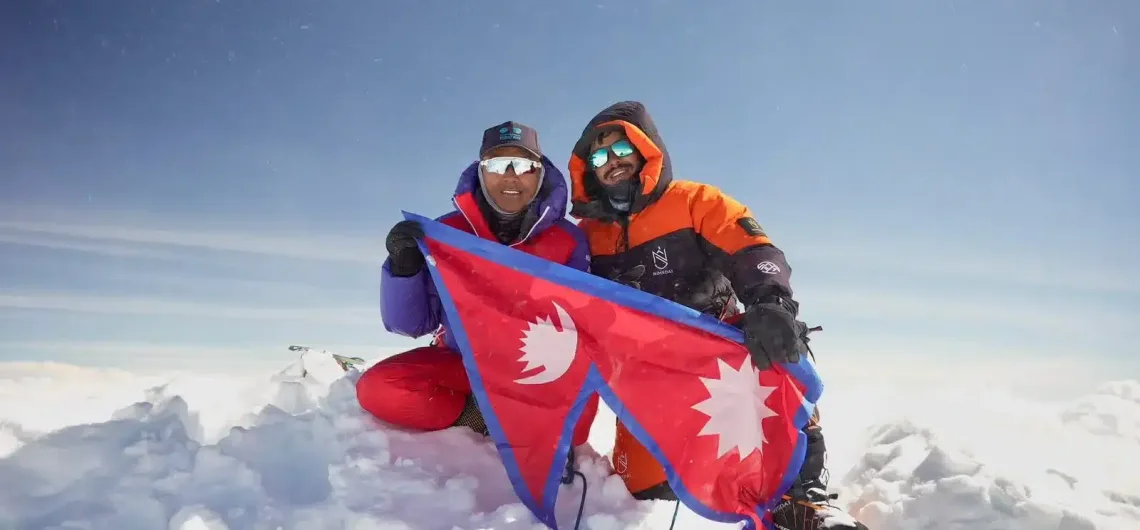
Nirmal Purja really shaped modern mountaineering into what it is today. Better known to many as Nims or Nimsdai, a name that combined his shortened name Nirmal (nims) and a word used widely in Nepali culture, “Dai,” which basically means BROTHER; hence, Nims Dai meaning brother Dai. He really put the local Nepalese Sherpas on the world map and broke records in record time, for example, becoming the fastest person to climb all the 14 8000m peaks. Before pouring our hearts into his tribute, he was the founder of Elite Exped alongside Mingma David Sherpa, a premier high-altitude guiding company that specializes in commercial expeditions to the world’s most challenging peaks, like all of the 14 eight-thousanders in the world. Apart from that, he also organised expeditions to other countries around the world, including climbing Mount Kilimanjaro. He was a Nepali-British mountaineer who first served in the British Army’s Brigade of Gurkhas and later in the Royal Navy’s Special Boat Service before turning full-time to the world’s highest peaks. In 2019 he climbed every one of the fourteen mountains above 8,000 metres in six months and six days while using bottled oxygen, a mark that stood until 2023. He was the first climber to stand on the tops of Everest, Lhotse and Makalu inside 48 hours, and in January 2021 he and nine fellow Nepalis completed the first winter ascent of K2. Many regarded him as one of the outstanding figures in modern high-altitude climbing. On 30 July 2026, an avalanche on Broad Peak in Pakistan killed him and the nine other members of his team.
Early Life
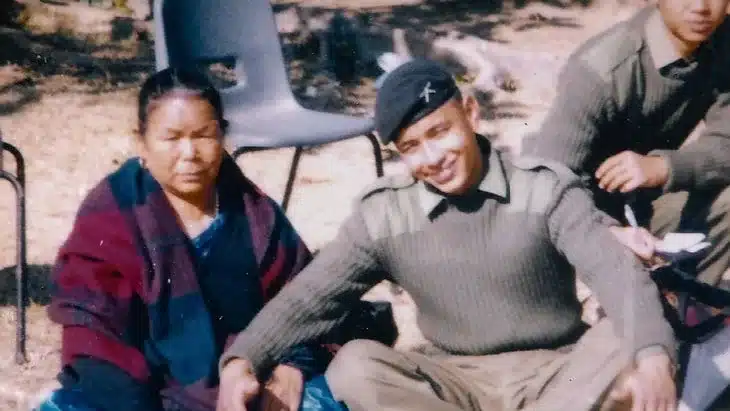
He was born in the small village of Dana in Nepal’s Myagdi District, not far from Dhaulagiri and roughly 1,600 metres above sea level. The fourth of five children of Nanda Bahadur Purja and Purna Kumari, he grew up in a household that had been shut out by both sides of the family because his parents came from different castes. His father had served as a Gurkha; his mother came from a farming background. Money was scarce. Purja later told National Geographic that as a child he did not even own a pair of flip-flops. When he was four, the family moved down to the Chitwan District closer to Kathmandu. His three older brothers also became Gurkha soldiers and paid for him to attend an English-medium boarding school, where he took up kick-boxing. In time he studied at Loughborough University in England and earned a postgraduate diploma in security management.
Military Career (2003–2018)
In 2003 he joined the Brigade of Gurkhas. Six years later he was selected for the Special Boat Service, the first Gurkha ever to do so, and specialised in cold-weather warfare. He served in every major theatre in which British forces were engaged and once survived a sniper round that hit the butt of his rifle only centimetres from his neck. By 2018 he was an important financial support for his extended family. Resigning that year meant walking away from a full military pension—an amount he called life-changing—so that he could concentrate on mountaineering.
The Fatal Decision That Ended Nims Dai’s Record Chase
Nirmal “Nims Dai” Purja’s death on Broad Peak on 30 July 2026 was not simply the result of bad luck in the mountains. It stemmed from a pair of deliberate choices made in the final days of his Pakistan expedition: a last-minute decision to add Broad Peak in pursuit of an unprecedented record, and the subsequent choice to push ahead when other teams had already withdrawn because of dangerous snow conditions. Together, those decisions placed him and nine companions on a highly unstable slope at the worst possible moment. In the video below, he shares his decision to climb Broad Peak.
The Strategic Decision: Chasing a New World Record
Purja’s original plan for the 2026 Karakoram season was modest by his standards. He intended only to climb Gasherbrum II. That ascent would have added another eight-thousander to his already extraordinary tally. But shortly before departure he reviewed his climbing statistics and saw a rare historical opportunity within reach. If he could also summit Broad Peak and then Cho Oyu, he would become the first person ever to complete all fourteen of the world’s 8,000-metre peaks twice without supplemental oxygen. The realisation changed everything. In his final social-media posts, he openly described Broad Peak as a late addition to the itinerary, an opportunistic extension of the trip. The hunger to rewrite the record books once more overrode the original, simpler plan. He and his Elite Exped team therefore committed themselves to a compressed timetable that left little room for caution.
The Tactical Decision: Pushing Through Dangerous Conditions.
By late July, the climbing season in the Karakoram was drawing to a close. Heavy snowfall had blanketed the range, creating widespread wind-drifted slabs and elevating the avalanche risk to extreme levels. Several other international expeditions recognised the danger and abandoned Broad Peak, retreating to base camp or leaving the mountain entirely. Purja chose differently. With the weather window narrowing and the season ending, he elected to use what remained of the unstable conditions for a summit push. On the morning of 30 July, the team moved up the west ridge between Camp II and Camp III, crossing a 30-to-45-degree slope known for its exposure to wind-loaded snow.
At approximately 9:30 a.m. local time, a large slab avalanche fractured above them. The slide swept all ten climbers—Purja, five other Nepalis, one Pakistani, one American, one Omani, and one Chinese—down the mountain face. None survived. Rescue teams later recovered the bodies over the following days under difficult conditions.
Broad Peak Avalanche: Nirmal Purja Nims among 10 dead after Pakistan accident
Climbing Career (2012–2026)
Early Himalayan Ascents
His first serious Himalayan climb came in 2012 when he reached the top of Lobuche East with no prior experience. On 18 May 2014, he summited his first eight-thousander, Dhaulagiri, in a round-trip of just fifteen days. Everest followed on 13 May 2016. The next year he led a team of thirteen Gurkhas to the summit of Everest on 15 May to mark two centuries of Gurkha service in the British Army. Over his career he stood on Everest nine times: 13 May 2016, 15 May 2017, 27 May 2017, 22 May 2019, 31 May 2021, 15 May 2022, 28 May 2022, 17 May 2023 and 27 May 2026.
Project Possible 14/7
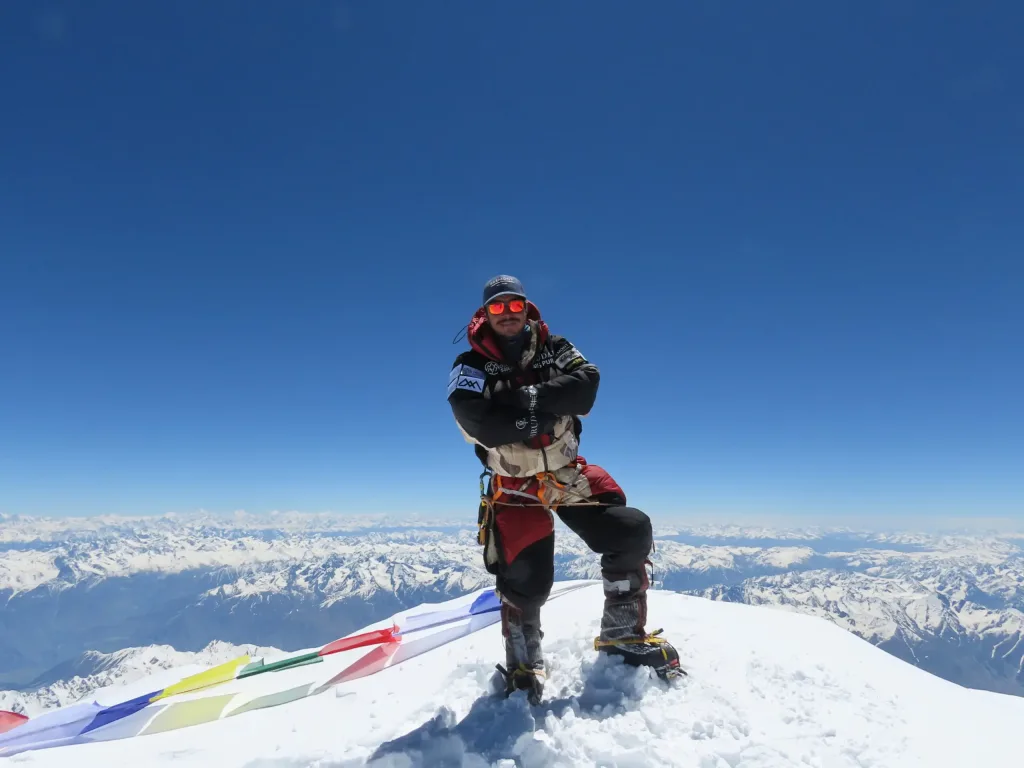
The project that made him famous began in April 2019. Calling it Project Possible 14/7, he set out to climb all fourteen eight-thousanders in seven months. The first phase finished on 24 May after he had topped Annapurna, Dhaulagiri, Kangchenjunga, Everest, Lhotse and Makalu, the last five of them in only twelve days. With partners that included Mingma Gyabu “David” Sherpa, Lakpa Dendi, Geljen Sherpa and Tensi Kasang, he reset his own Guinness record by linking Everest, Lhotse and Makalu in two days and thirty minutes. In July he moved to Pakistan and climbed Nanga Parbat (3 July), Gasherbrum I (15 July), Gasherbrum II (18 July), K2 (24 July) and Broad Peak (26 July). The final phase started in September with Cho Oyu on 23 September and Manaslu on 27 September. After the Nepali government helped secure a special autumn permit, he reached the summit of Shishapangma on 29 October and closed the project in six months and six days. Later research showed that on Dhaulagiri and Manaslu he had stopped short of the true geographical summits; he returned to both peaks in autumn 2021 to correct that. Along the way he also claimed the most eight-thousanders in a single spring (six) and a single summer (five), the fastest combination of the three highest peaks, the five highest peaks, the lower three Gasherbrums and Broad Peak, and the higher consecutive trio of Everest-Lhotse-Makalu. A photograph he took of the overcrowded fixed ropes on Everest that May went viral and appeared in the New York Times. The whole effort became the Netflix documentary 14 Peaks: Nothing Is Impossible, released in November 2021.
First Winter Ascent of K2
On 16 January 2021, Purja and nine other Nepalis made the first winter ascent of K2. His group—Mingma David Sherpa, Mingma Tenzi Sherpa, Geljen Sherpa, Pem Chiri Sherpa, Dawa Temba Sherpa and himself—joined forces with climbers from Mingma Gyalje Sherpa’s team and Sona Sherpa of Seven Summits Treks after storms damaged lower camps. They stood on the summit at 16:58 local time. Purja was the only member of the combined party to climb without bottled oxygen, the first person ever to do so in winter on K2.
Further Achievements
Further records followed. In May 2022 he linked Kangchenjunga, Everest and Lhotse without oxygen in eight days, twenty-three hours and ten minutes. On 4 October 2024 he finished the fourteen peaks without supplemental oxygen in two years and five months, becoming the first to hold both the oxygen and no-oxygen records. Seventeen days later he completed the Seven Summits the same way. In 2025 he announced the Hat-Trick Challenge—climbing the fourteen eight-thousanders and the Seven Summits for a third time—funding it himself so that every sponsorship and donation went to the Nimsdai Foundation. The foundation supports education, emergency relief, and environmental work in mountain communities; its highest-profile project remains the Big Mountain Clean Up. On 3 July 2025 he summited Nanga Parbat for the third time, his fiftieth successful eight-thousander and twenty-second without oxygen, setting new marks for most total and most oxygen-free ascents. In May 2026 he improved his own Everest-to-Lhotse traverse without oxygen to thirteen hours and then climbed Makalu, pushing his career total of eight-thousander summits to fifty-six.
List of Eight-Thousander Ascents
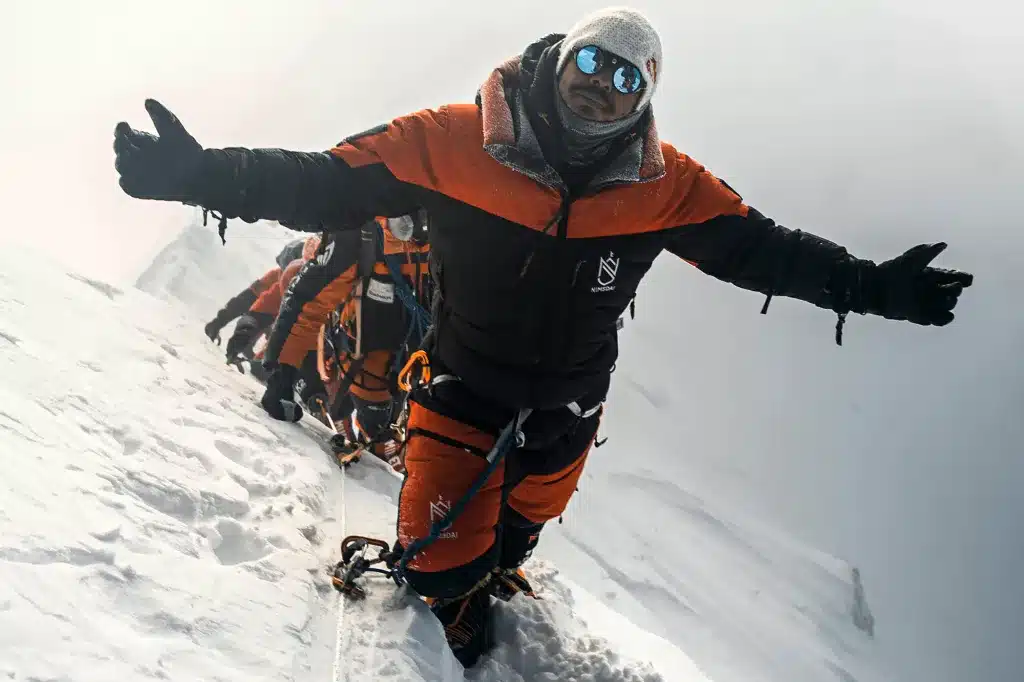
Independent research published in 2022 could verify only three climbers—Purja, Ed Viesturs and Veikka Gustafsson—as having reached the true geographical summits of all fourteen peaks. Purja’s complete list of eight-thousander ascents runs as follows:
- Everest (8,848 m): 13 May 2016, 15 May 2017, 27 May 2017, 22 May 2019, 31 May 2021, 15 May 2022, 28 May 2022, 17 May 2023, 27 May 2026
- K2 (8,611 m): 24 July 2019, 16 January 2021, 22 July 2022
- Kangchenjunga (8,586 m): 15 May 2019, 7 May 2022, 18 May 2025
- Lhotse (8,516 m): 27 May 2017, 22 May 2019, 16 May 2022, 28 May 2022, May 2023, 27 May 2026
- Makalu (8,485 m): 1 June 2017, 24 May 2019, 5 June 2023
- Cho Oyu (8,188 m): 23 September 2019, 2 October 2023
- Dhaulagiri (8,167 m): 18 May 2014, 12 May 2019, 8 October 2021
- Manaslu (8,163 m): 27 September 2019, 27 September 2021, 25 September 2025
- Nanga Parbat (8,125 m): 3 July 2019, 2 July 2023, 3 July 2025
- Annapurna (8,091 m): 23 April 2019, April 2023, 15 April 2024
- Gasherbrum I (8,080 m): 15 July 2019, 21 July 2023, July 2025
- Broad Peak (8,051 m): 26 July 2019, 25 July 2023, July 2025
- Gasherbrum II (8,034 m): 18 July 2019, 17 July 2023, 21 July 2026
- Shishapangma (8,027 m): 29 October 2019, 4 October 2024
Personal Life
Purja was of Magar ethnicity and was raised Hindu. His father and three older brothers had all served as Gurkhas; becoming one himself had been his childhood ambition. In 2006 he married Suchi Purja, herself the daughter of a Gurkha and a dental professional. They settled in Eastleigh near Southampton and had one daughter. Suchi appeared with him in the Netflix film, which also showed the strain his long absences placed on the family. Leaving the SBS and remortgaging the house to fund Project Possible created real tension: his wife worried about the risks, his mother was seriously ill, and one brother opposed the decision to abandon a secure pension. When he left Heathrow for Kathmandu, he had raised only about fifteen percent of the money he needed. Loughborough University later awarded him an honorary doctorate in December 2023 for both his military service and his climbing records.

Controversies
Climbing Style and Summit DebatesHis methods drew criticism. Traditional alpinists pointed out that Project Possible relied on bottled oxygen, fixed ropes, established routes, and helicopter transfers between peaks, arguing that logistics played as large a role as pure climbing skill. The incomplete summits of Dhaulagiri and Manaslu in 2019 led Guinness to adjust the original record after he returned to both mountains in 2021. In 2023 Kristin Harila and Tenjen Lama Sherpa finished all fourteen peaks in ninety-two days.
Sexual Misconduct Allegations
In May 2024 the New York Times published allegations of sexual misconduct made by April Leonardo and Lotta Hintsa concerning separate incidents in 2022 and 2023. Neither woman contacted the police. Hintsa had already described an unnamed famous climber kissing her without warning in her 2023 memoir; her account to the newspaper was more detailed, alleging that Purja led her to a bed, touched her, tried to remove her bra despite resistance, and masturbated in front of her. Purja’s lawyer called the claims false and defamatory. He later said the article left out context from witnesses and addressed the matter in a four-part podcast series titled Summit Justice.
Dispute with The Himalayan Times
In 2025, the Nepal Press Council blacklisted The Himalayan Times and withdrew government advertising after investigating seventeen articles the paper had published about Purja and his companies Skydive Nimsdai and Elite Exped. The council found the coverage unilateral, imbalanced and aimed at creating hatred. The newspaper replied that the decision was arbitrary and unconstitutional.
Nims Dai’s Death
On 30 July 2026, Purja was climbing Broad Peak with a ten-person team that included American Mallory Geis, Chinese Wang Zhong, Nepali Pur Bahadur Gurung and Omani Nadhira Al Harthy. At about 9 a.m. local time, an avalanche struck them between Camps 2 and 3 on the west ridge at roughly 6,600 metres. All ten were confirmed dead on 1 August by Elite Exped. Purja’s body was recovered on 2 August at about 5,700 metres by a joint Nepali-Pakistani team led by Mingma G, with support from Sirbaz Khan, Abid Baig, Sherzad, Dipen Gurung and Pema Chhewang Sherpa. The Alpine Club of Pakistan later confirmed that the bodies of Purja, Zhong Wang, Nima Sherpa and Kilu Sherpa had been brought to Base Camp after a difficult high-altitude recovery.
Tributes
Prince William called him one of the world’s greatest mountaineers and sent thoughts to the families. Bear Grylls described him as a remarkable and unique man with an unstoppable spirit. Nepal’s Prime Minister Balen Shah said his courage and dedication would always remain inspiring. Even mountaineering greats like Reinhold Messner, Mingma David Sherpa, Lhakpa Sherpa, Bear Grylls, Dan Mazur and Conrad Anker, among others, shared their grief on social media.
Honours
In 2018 Queen Elizabeth II appointed him a Member of the Order of the British Empire for outstanding achievement in extreme high-altitude mountaineering. In November 2023, he received the ISPO Cup Award in Düsseldorf for his career and the work of the Nimsdai Foundation. The honorary degree from Loughborough followed the same December.
Filmography and Books
He appeared as himself in the 2021 Netflix film 14 Peaks: Nothing Is Impossible. His book Beyond Possible was published by Hodder & Stoughton on 12 November 2020.

