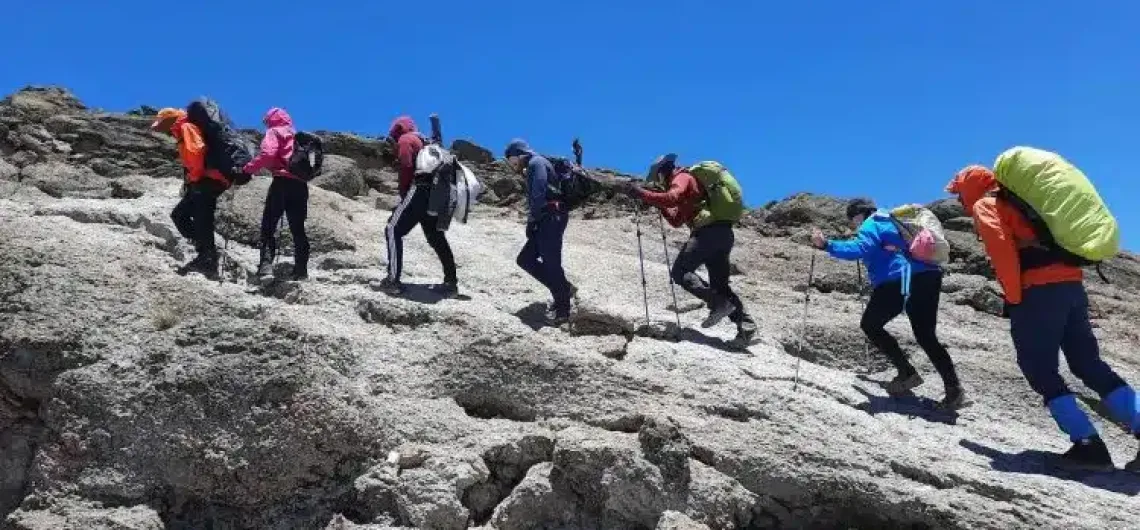
Acute Mountain Sickness (AMS) is the most common reason people fail to reach the summit of Kilimanjaro. It affects a large percentage of climbers, especially on shorter routes. The good news is that AMS is largely preventable if you follow the right strategies. At 5,895 metres (19,341 ft), Uhuru Peak on Mount Kilimanjaro is the highest point in Africa — and one of the most accessible high-altitude summits in the world. However, reaching it comes with a significant physiological challenge that many climbers underestimate: high altitude illnesses. Know the high altitude illnesses These conditions occur when the body struggles to adapt to the reduced oxygen levels at elevation. The three main high altitude illnesses are: Acute Mountain Sickness (AMS) — the most common and usually the mildest form High Altitude Cerebral Edema (HACE) — a severe, life-threatening swelling of the brain High Altitude Pulmonary Edema (HAPE) — a dangerous buildup of fluid in the lungs On Kilimanjaro, AMS is by far the most frequently encountered issue. Research and operator data consistently show that a large percentage of climbers experience some degree of altitude-related symptoms. Studies indicate that over 50% of climbers on Kilimanjaro suffer from AMS at some point during their ascent, with incidence rates climbing significantly above 4,000 metres. On shorter itineraries (5–6 days), the risk is notably higher due to faster rates of ascent. The impact is clearly visible in summit success rates. While overall success rates across all routes average between 65–75%, these figures vary dramatically depending on the itinerary. On well-acclimatised routes such as the 8-day Lemosho or the 8–9 day Northern Circuit, success rates often exceed 90%. In contrast, shorter or more aggressive routes see noticeably lower completion rates, with AMS being one of the leading causes of climbers turning back. What makes Kilimanjaro particularly
Acute Mountain Sickness (AMS) is the most common reason people fail to reach the summit of Kilimanjaro. It affects a large percentage of climbers, especially on shorter routes. The good news is that AMS is largely preventable if you follow the right strategies. At 5,895 metres (19,341 ft), Uhuru Peak on Mount Kilimanjaro is the
The term "Pole Pole" is thrown around a lot on the mountain. Not just on the mountain, even when we pick you up, it is the most popular word that we will teach you, of course, alongside the ever-popular greeting "Jambo!" Hakuna matata is another word, but it correlates with pole pole; it tells you to take it slow, no worries, take it slow, and everything will just be fine. Do not rush, because climbing Kilimanjaro is not a 100 metre dash; it is like a marathon of some sort, a test of your stamina and endurance. If you’ve ever researched climbing Mount Kilimanjaro, you’ve probably come across the phrase “pole pole”. It’s not just a cute Swahili saying — it’s the golden rule of the mountain, repeated constantly by guides, porters, and fellow climbers. Pole pole (pronounced poh-lay poh-lay) literally means “slowly slowly” in Swahili. On Kilimanjaro, it’s more than advice — it’s a survival strategy. Jambo Bwana! The Hakuna Matata Kilimanjaro Song Why “Pole Pole” Matters So Much Kilimanjaro is a high-altitude trek, not a technical climb. The biggest challenge isn’t the steepness or distance — it’s altitude. Your body needs time to adjust to the decreasing oxygen levels as you gain elevation. Rushing leads to: Acute Mountain Sickness (AMS) Headaches, nausea, and fatigue Poor sleep Higher chance of turning back before the summit Pole pole forces a steady, sustainable pace that dramatically increases your chances of success. Routes with better “climb high, sleep low” profiles (like the Lemosho and Northern Circuit) naturally support this philosophy — which is why they consistently deliver the highest summit success rates (often 90%+ on the longer itineraries). Below are the longer itineraries we recommend. 9 days Northern Circuit Route 8 days Lemosho Route Itinerary 9 Days Crater Camp Route & Lemosho
The term “Pole Pole” is thrown around a lot on the mountain. Not just on the mountain, even when we pick you up, it is the most popular word that we will teach you, of course, alongside the ever-popular greeting “Jambo!” Hakuna matata is another word, but it correlates with pole pole; it tells you
We usually recommend the two routes originating from the western side of Kilimanjaro as the best when it comes to elevation gain and gradual slope profiles, which means a better summit success rate and fewer altitude sickness symptoms. These two routes, Lemosho and Northern Circuit, are newer introduced routes on the mountain compared to the other older routes like Marangu and Machame, to make it easier for climbers to reach Uhuru Peak. For a while, Marangu used to be the "easiest route," but things have changed ever since these two routes were introduced. When climbers ask about “elevation gain” on Mount Kilimanjaro, they’re usually thinking beyond the raw net gain (roughly 3,500–4,300 m / 11,500–14,100 ft from any starting gate to Uhuru Peak at 5,895 m). What really matters is the daily elevation profile — how steep the daily climbs are, how much “climb high, sleep low” acclimatization is built in, and how gradually your body is exposed to altitude. A favourable profile means smaller daily gains (ideally 500–800 m), extra acclimatization days, and sleeping lower than the day’s highest point. This dramatically improves summit success rates and reduces altitude sickness risk. A poor profile means big daily jumps (often 1,000 m+), rapid ascents, and minimal recovery time at lower elevations. Here is the clear ranking based on current 2025–2026 operator data, GPS-tracked itineraries, and success-rate statistics: See all the routes we offer | Mount Kilimanjaro Tour Packages Best / Most Favourable Elevation Gain: Northern Circuit (8–9 days) Book the 9 days Northern Circuit Route Itinerary Why it wins: Longest route on the mountain with the most gradual daily gains and multiple built-in “climb high, sleep low” days. It starts like Lemosho on the western side but circles the entire mountain, giving your body maximum time to adapt. Net gain
We usually recommend the two routes originating from the western side of Kilimanjaro as the best when it comes to elevation gain and gradual slope profiles, which means a better summit success rate and fewer altitude sickness symptoms. These two routes, Lemosho and Northern Circuit, are newer introduced routes on the mountain compared to the
Mount Kilimanjaro's total vertical elevation gain, with your sum ascent of all day-to-day segments to reach Uhuru Peak, standing at an official elevation of 5,895 meters (19,341 feet) above sea level, can vary from route to route and the number of days for your hike. Reaching the summit is a non-technical trek, but the elevation gain you experience is one of the biggest physical and physiological challenges. Unlike mountains with a single straight ascent, Kilimanjaro’s routes involve gradual climbs through five distinct ecological zones, with built-in acclimatization days that include some descent and re-ascent.“Elevation gain” has two important meanings on Kilimanjaro: Net elevation gain: The difference between your starting gate and the summit (typically 3,500–4,300 meters / 11,500–14,100 feet depending on the route). Total cumulative ascent: The actual uphill distance you hike, which is higher because of valleys, ridges, and acclimatization hikes (often 4,500–5,200 meters / 14,800–17,000 feet total). The extra ascent from undulations is what makes longer routes like Lemosho excellent for acclimatization — you “climb high, sleep low.” Acclimatization for Mount Kilimanjaro Elevation Gain by Popular Route Here is a factual comparison based on data gathered by Tranquil Kilimanjaro guides and GPS-tracked itineraries (figures are approximate and can vary slightly by exact trailhead and side hikes): Route Starting Elevation Net Gain to Summit Approx. Total Ascent Typical Duration Success Rate (8+ days) Lemosho 2,100–2,360 m (6,890–7,743 ft) ~3,535–3,795 m (11,600–12,450 ft) 4,800–5,000 m (15,700–16,400 ft) 7–8 days 90–95% Machame 1,640–1,800 m (5,380–5,906 ft) ~4,095–4,255 m (13,400–14,000 ft) ~4,800–5,200 m 6–7 days 85–90% Marangu 1,843–1,879 m (6,047–6,164 ft) ~4,016–4,052 m (13,176–13,384 ft) ~4,300 m 5–6 days 65–70% Rongai 1,950–2,364 m (6,398–7,756 ft) ~3,531–3,945 m (11,585–12,900 ft) ~4,200 m 6–7 days 85% Umbwe 1,800 m (5,906 ft) ~4,095 m (13,435 ft) ~4,500 m 5–6 days Lower Daily Net Elevation Gain
Mount Kilimanjaro’s total vertical elevation gain, with your sum ascent of all day-to-day segments to reach Uhuru Peak, standing at an official elevation of 5,895 meters (19,341 feet) above sea level, can vary from route to route and the number of days for your hike. Reaching the summit is a non-technical trek, but the elevation