
No, K2 and Mount Kilimanjaro are completely different mountains.
K2 is vastly more difficult, dangerous, and technically demanding than Kilimanjaro. While Kilimanjaro is a challenging high-altitude trek that many fit hikers can complete, K2 is one of the world’s hardest 8,000 m peaks, known for its extreme objective dangers and low success rate. Kilimanjaro is often used as a stepping stone or training peak for more serious mountaineering goals like K2 or Everest.
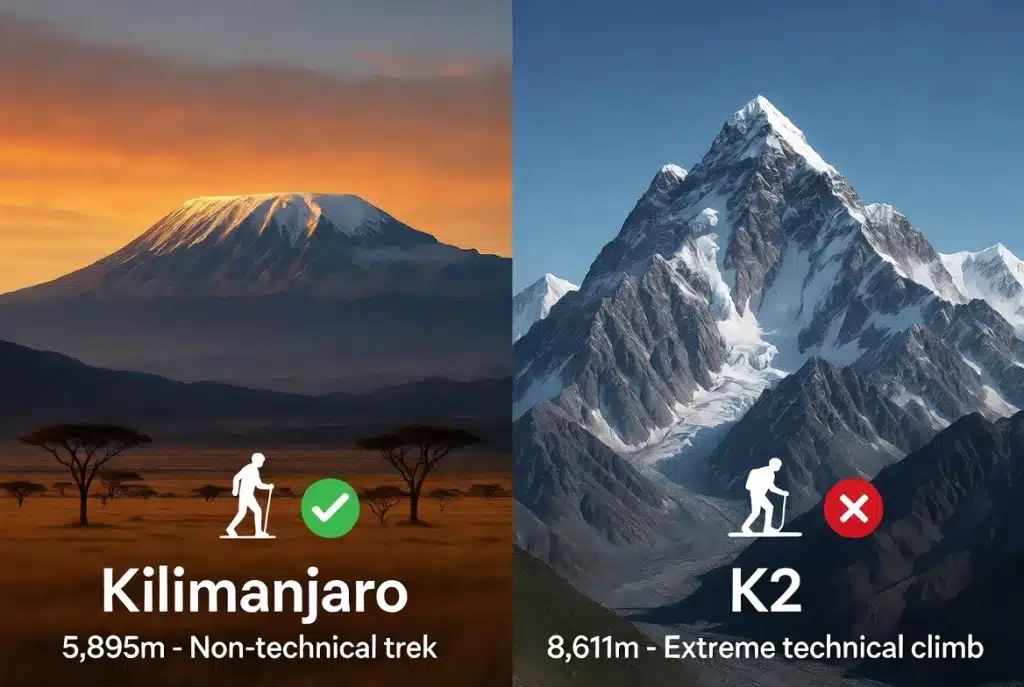
K2 vs Mount Kilimanjaro: A Factual Comparison
Here is a clear, side-by-side comparison of the two mountains based on verified geographical and climbing data:
| Category | Mount Kilimanjaro | K2 (Mount Godwin-Austen) | Winner (Harder) |
|---|---|---|---|
| Location | Tanzania, Africa | Pakistan/China border, Karakoram Range | – |
| Height | 5,895 m (19,341 ft) | 8,611 m (28,251 ft) | K2 |
| Type | Free-standing stratovolcano | Tectonic peak in the Karakoram range | – |
| Technical Difficulty | Non-technical (trekking only) | Extremely technical (ice, rock, fixed ropes) | K2 |
| Typical Duration | 6–9 days | 6–8 weeks (full expedition) | K2 |
| Average Success Rate | 60–70% (up to 90%+ on longer routes) | ~20–35% (highly variable by year) | K2 |
| Main Risks | Altitude sickness, cold, exhaustion | Extreme altitude, avalanches, storms, crevasses, high fatality rate | K2 |
| Skill Level Required | Beginner to intermediate (good fitness) | Advanced mountaineering experience required | K2 |
| Cost (approximate) | $2,000 – $6,000 | $30,000 – $100,000+ | K2 |
1. Location and Geology
- Kilimanjaro: Located in Tanzania, near the equator in East Africa. It is a massive free-standing stratovolcano that rises dramatically from the surrounding plains. It is not part of any mountain range. It consists of three volcanic cones (Kibo, Mawenzi, and Shira).
- K2: Located on the border between Pakistan and China in the Karakoram Range (part of the greater Himalayan system). It is a rugged, tectonic peak formed by the collision of the Indian and Eurasian plates.
2. Height and Structure
- Kilimanjaro: 5,895 m (19,341 ft). It is Africa’s highest mountain and the world’s highest free-standing mountain (measured from base to summit).
- K2: 8,611 m (28,251 ft). It is the second-highest mountain in the world after Everest.
3. Technical Difficulty
- Kilimanjaro: Non-technical. No ropes, ice axes, or advanced mountaineering skills are required on standard routes. It is essentially a very long, high-altitude hike.
- K2: Extremely technical and dangerous. Climbers must use crampons, ice axes, fixed ropes, and navigate steep ice, rock, and seracs. It is considered one of the most difficult 8,000 m peaks.
4. Duration and Logistics
- Kilimanjaro: Typically 6–9 days. You sleep in tents or huts and are supported by a large team of guides and porters.
- K2: Full expeditions last 6–8 weeks. Climbers spend weeks at base camp and higher camps, dealing with extreme weather windows and complex logistics.
5. Success Rates and Risks
- Kilimanjaro: Average success rate is around 60–70%, and can reach 85–95% on longer, well-acclimatized routes. Main risks are altitude sickness, cold, and exhaustion. The fatality rate is very low.
- K2: Success rate is much lower (20–35% in good years). It has a notoriously high fatality rate due to avalanches, storms, crevasses, and the “Death Zone” (above 8,000 m) where the human body deteriorates rapidly.
6. Skill Level and Physical Demand
- Kilimanjaro: Suitable for fit beginners to intermediate hikers with good cardiovascular endurance.
- K2: Requires advanced mountaineering experience, technical skills, and exceptional physical and mental toughness.
7. Cost
- Kilimanjaro: $2,000 – $6,000 for a standard guided climb.
- K2: $30,000 – $100,000+ for a full expedition (permits, oxygen, high-altitude porters, etc.).

