
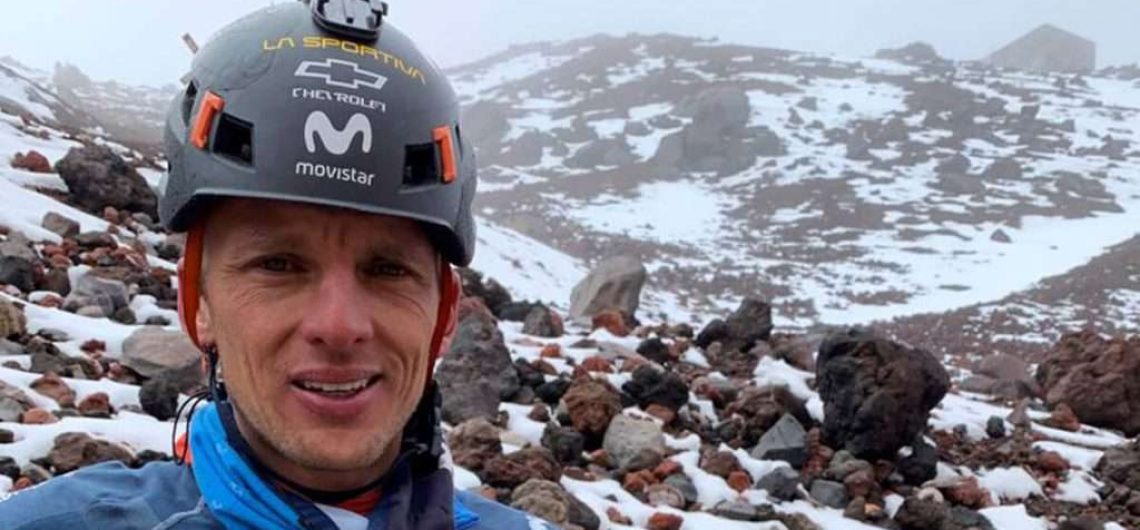
Last year, we hosted Lenka Poláčková and her amazing husband, Jan. She just wanted to do Kilimanjaro the normal way, to complete her 7 summits circuit. There were moments when she thought about smashing the standing speed record on Kilimanjaro for any female. So in the thick of the discussion, we had settled on the Umbwe Route, then it dawned on me, like, realistically, Umbwe is the ladder of this mountain, brief and straight to the point. In the end, because of time constraints, she opted for doing a short safari instead of trail running on Kilimanjaro. In the shadow of Africa’s highest peak, where the air thins to a whisper and every step feels like a battle against gravity, a select group of athletes—trail runners and record breakers—keep returning to one path: the Umbwe Route. While most climbers opt for the gentler, more popular trails like Machame or Lemosho, these endurance elites seek out Umbwe for its brutal honesty. It is the shortest, steepest, and most direct line to Uhuru Peak (5,895 m / 19,341 ft). No switchbacks to ease the burn, no leisurely acclimatization days built in—just raw, relentless vertical gain through pristine rainforest, exposed ridges, and high-alpine desert. For those who live for personal bests, FKTs (fastest known times), and the pure joy of pushing human limits, Umbwe isn’t just a route. It’s a proving ground.
Read more about the Umbwe Route.
The Umbwe Route: Kilimanjaro’s Steepest and Most Demanding Trail
Umbwe stands apart from Kilimanjaro’s six other established routes. Starting at Umbwe Gate (around 1,800 m / 5,900 ft) on the mountain’s southern slopes, it punches straight up through dense montane forest, following narrow ridges between the Lonzo and Umbwe rivers. In the first two days alone, climbers gain over 2,300 meters (7,500 ft) in roughly 17 km (10.5 miles), reaching Barranco Camp at 3,900 m (12,800 ft). From there, it merges with the Southern Circuit—traversing the dramatic Barranco Wall (a short, hands-on scramble), Karanga Camp, and Barafu Camp—before the final summit push. Total gate-to-gate distance is about 47–53 km (29–33 miles), making it the shortest full ascent on the mountain.
Compare that to longer routes like the 7- to 9-day Lemosho or Northern Circuit, which offer gradual elevation profiles and better acclimatization. Umbwe’s average daily gain hovers around 860 m (2,820 ft), with sustained inclines often exceeding 20–30% in the early sections—relentless, root-strewn, and boulder-choked. It is non-technical (no ropes or ice axes required), but the exposure on narrow ridges and the psychological grind of constant upward pressure make it feel far more demanding. Success rates hover around 60%—among the lowest—precisely because the rapid altitude gain leaves little room for the body to adapt. Yet for trail runners and record chasers, that same intensity is the draw.
The Siren Call of Speed: Why Directness Wins for Record Breakers
Record breakers don’t climb Kilimanjaro—they attack it. And Umbwe is the perfect weapon. Its direct southern approach shaves kilometers off the journey to the summit compared to looping western or northern routes. Every meter saved translates to minutes (or hours) shaved from a clock that matters deeply to these athletes. The route’s speed-record legacy is legendary. In 2010, Spanish trail-running superstar Kilian Jornet blasted from Umbwe Gate to Uhuru Peak in 5 hours, 23 minutes, and 50 seconds. Four years later, Swiss-Ecuadorian mountain guide Karl Egloff obliterated that mark, reaching the summit via Umbwe in 4 hours, 56 minutes, before descending via the Mweka Route for a combined round-trip time of 6 hours, 42 minutes, 24 seconds (some sources cite the full record as 6h 56m). These feats remain benchmarks more than a decade later. Local hero Simon Mtuy, a Tanzanian guide and ultrarunner, still holds the “unaided” record (carrying all his own gear, food, and water): 9 hours, 19 minutes round-trip on Umbwe in 2006. More recently, in early 2026, Danish runner Kristina Schou Madsen set a new women’s ascent record on Umbwe at 6 hours, 52 minutes, and 54 seconds—surpassing previous marks by a significant margin. German athlete Anne-Marie Flammersfeld set the women’s combined record in 2015 via the same route in 8 hours, 32 minutes. What makes Umbwe the record-breaker’s choice? Simple geometry and physiology. The steep, switchback-free profile rewards powerful, efficient stride turnover—the same skills trail runners hone on technical singletrack and vert-heavy races like the UTMB or Hardrock 100. There’s no wasted lateral movement; it’s pure vertical efficiency. Runners can maintain momentum through the forest and moorland zones before the thin air above 4,000 m demands every ounce of aerobic capacity.
See: Fastest climbs of Mount Kilimanjaro on record featuring Karl Egloff, Simon Mtuy and Kílian Jornet
Trail Runners’ Paradise: Endurance, Solitude, and Raw Challenge
Trail runners don’t just tolerate Umbwe’s difficulty—they crave it. The route transforms a standard Kilimanjaro trek into an ultra-endurance test. The early rainforest section is a technical playground: slick roots, embedded rocks, and steep climbs that demand quad-burning power hikes and precise foot placement. By day two, runners emerge onto dramatic ridges with sweeping views of the Southern Glaciers—pristine, crowd-free terrain that feels worlds away from the highway-like traffic on Marangu or Machame.
Solitude is another massive draw. While thousands queue up other routes during peak seasons, Umbwe sees a fraction of the foot traffic. For athletes training for self-supported ultras or FKT attempts, this isolation sharpens focus. No distractions, no porters clogging the trail—just you, your breathing, and the mountain. The Barranco Wall scramble adds a fun, low-fifth-class element that tests scrambling skills without true mountaineering risk. Physiologically, the route is a high-altitude training camp on steroids. The rapid gain mimics the demands of sky-running or alpine ultras, forcing runners to confront altitude sickness head-on. Those who succeed often credit Umbwe with forging unbreakable mental toughness. As one veteran trail runner put it in climbing forums, the route’s “relentless incline and minimal switchbacks” turn every step into a micro-battle—perfect preparation for races where suffering is the currency.
Untamed Beauty: Scenery That Rewards the Bold
Umbwe isn’t all pain. Its direct southern line delivers some of Kilimanjaro’s most dramatic scenery in condensed form. The lower section winds through lush, moss-draped forest alive with monkeys and birdsong. As the trail steepens onto the ridge, the canopy opens to reveal the mountain’s iconic flanks—glaciers gleaming in the sun, the vast Shira Plateau to the west, and the Mawenzi peak rising dramatically to the east. Higher up, the landscape shifts to giant heathers, then barren scree and snowfields. Few routes offer such rapid ecological transitions in under 48 hours.
For record breakers chasing dawn summits or sunset ridge runs, the light on Umbwe is magical—golden hour on the Barranco Wall or alpenglow on the glaciers creates moments of pure alpine poetry amid the grind.
What It Takes: Preparation for the Elite
Umbwe is not for novices. Record holders and serious trail runners arrive with high-altitude experience (think previous 4,000 m+ peaks), exceptional cardiovascular fitness, and strength training focused on steep power output. Pre-acclimatization strategies—sleeping in hypoxic tents or arriving early in Tanzania—are common. Most still add an extra day at Barranco for a summit-night buffer, even if pushing for speed. Guides and porters are essential for safety (Kilimanjaro National Park requires them), but the fastest athletes travel light, relying on elite support crews stationed at key points. Hydration, nutrition (high-calorie gels and electrolytes), and monitoring for acute mountain sickness (AMS) become non-negotiable rituals.
The Ultimate Test—and Why They Keep Coming Back
In an era of crowded trails and Instagram summits, the Umbwe Route remains a purist’s pilgrimage. It strips away the comforts of easier paths and demands everything: legs of steel, lungs that laugh at thin air, and a mind that thrives on discomfort. For trail runners, it’s the ultimate vert workout disguised as an adventure. For record breakers, it’s the fastest highway to glory on Africa’s roof. Whether you’re chasing a sub-7-hour round-trip or simply testing your limits on a 6-day push, Umbwe delivers an experience no other route can match—raw, direct, and unforgettable. That’s why the fastest and the fittest keep choosing the steepest path. Because on Umbwe, the mountain doesn’t just test you. It reveals you.
If you’re fit enough, experienced enough, and bold enough, the trail is waiting. Just remember: Umbwe doesn’t forgive weakness—but it rewards the brave with memories (and times) that will define a lifetime.

