
The number of porters on your Mount Kilimanjaro climb typically ranges from 2–4 porters per climber, depending on group size, route, duration, and operator standards. For a standard trek, expect around 3 porters per person on average.
Depending on your tour operator, group size, and quantity of equipment included in your package, a typical ethical Kilimanjaro climb will include 2 to 4 porters per climber. When climbing in groups of 20 or more, the porter-to-climber ratio can drop to 2.5 porters per climber. If you’re traveling alone, though, don’t be shocked if you have all six porters to yourself. You may have up to 8 porters per climber in extremely high-end packages that include a lot of luxury equipment. Even for similar products, routes, and group sizes, it’s conceivable that the number of porters differs between firms.
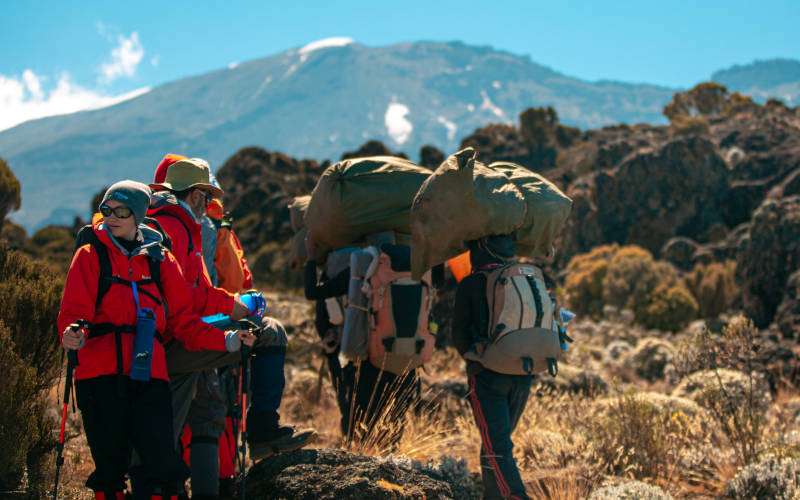
This is because some Kilimanjaro climbing companies provide all of the necessary supplies from the start, while others use “re-supply porters” to deliver new meals and cut down on porterage costs.
Typical Crew Composition
For a small group (e.g., 2–4 climbers) on a 7–8-day route:
- Porters — 2–4 per climber (they carry food, tents, cooking gear, your duffel bag, water, etc.).
- Guides — 1 lead guide + assistant guides (ratio often 1 guide per 2–3 climbers).
- Cook — 1 per group.
- Total crew — Can easily be 10–20+ people for a small group, as everything must be carried up and down.
Larger groups share some infrastructure (e.g., one cook for everyone), so the ratio improves slightly.
Why So Many Porters?
- Load limits — Porters are restricted to 20–25 kg max (including their personal gear) for safety and ethics (KPAP standards).
- What they carry — Tents, sleeping mats, food for the whole group, cooking equipment, water, your main duffel bag (~15 kg limit), and more. Nothing is left behind.
- Support roles — Some porters help set up camp, fetch water, or act as bathroom attendants if you have a private toilet tent.
What Affects the Number?
- Group size — Bigger groups need proportionally fewer extra porters.
- Route & days — Longer routes (e.g., 8–9 days Lemosho or Northern Circuit) require more food/gear, so more porters.
- Operator ethics — KPAP-partnered companies follow fair load limits and pay better, which may mean slightly higher numbers for proper support. Budget operators sometimes overload or understaff.
Your operator will confirm the exact crew size in your briefing. More porters generally mean better service, lighter loads for everyone, and higher ethical standards. It’s all part of what makes the supported Kilimanjaro experience unique!

