
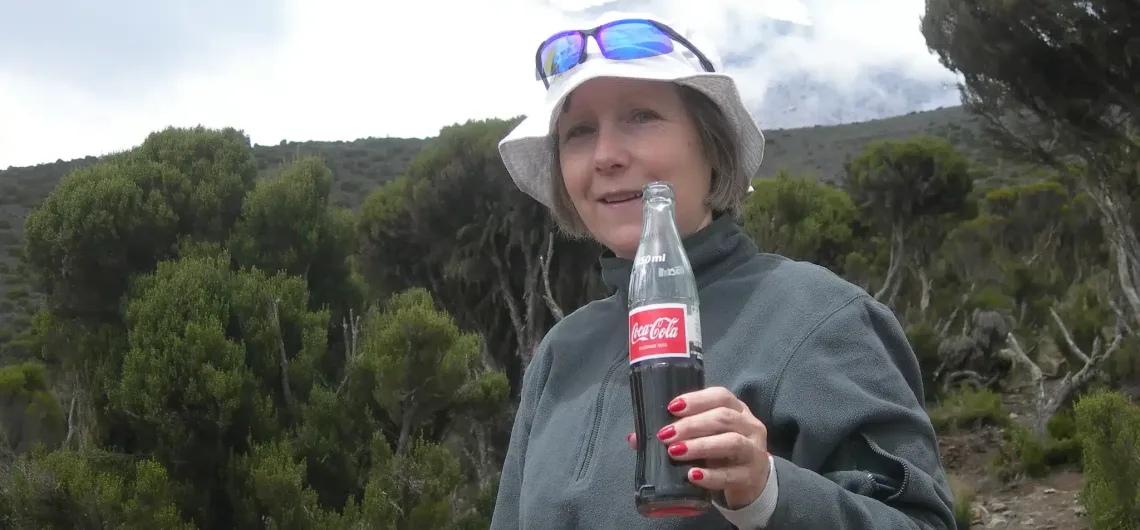
What memories do you have about the famous Coca-Cola Route on Mount Kilimanjaro? Imagine standing at the summit of Mount Kilimanjaro, Africa’s highest peak at 5,895 meters (19,341 feet), watching the sunrise paint the glaciers in hues of pink and gold. The wind whips around you, the air is thin, and your legs ache from the long night’s push—but you made it. For thousands of trekkers every year, this dream becomes reality via one very special trail: the Marangu Route, affectionately and famously known as the Coca-Cola Route. Learn more about the popular Marangu Route here.
Why “Coca-Cola”? It’s not just a quirky nickname slapped on by marketers. This route earned its moniker through a perfect storm of accessibility, comfort, commercial flair, and sheer popularity that mirrors the global beverage giant itself—ubiquitous, refreshing, reliable, and the first choice for millions. In this article as researched by our mountain guides, we’ll explore every facet: the route’s origins, exactly how the name came about (with three highlighted reasons), the era when rangers literally sold sodas at the huts, its enduring popularity akin to the Coca-Cola brand, why it’s long been considered the “easiest” path (just like cracking open an ice-cold Coke on a hot day), a full day-by-day breakdown, ecological wonders, preparation secrets, pros/cons, real hiker stories, comparisons to other routes, and why this trail remains a timeless classic in 2026 and beyond. Whether you’re planning your own ascent, reminiscing about a past climb, or simply dreaming of Kilimanjaro from your armchair, buckle up. This is the ultimate guide to the Coca-Cola Route.
Book our 6 & 5 Day Coca-Cola Route Packages
6 Days Marangu Route
5 Days Marangu Route
How the Name “Coca-Cola Route” Came About:
Three Highlighted Reasons: The nickname didn’t emerge overnight. It crystallised in the mid-to-late 20th century as tourism boomed post-independence. Here are the three primary reasons, drawn from historical accounts, guide testimonies, and trekker lore:
Reason 1: Rangers and Hut Staff Selling Sodas (and More) Back in the Day – The Literal Coca-Cola Factor
This is the most colourful and widely cited origin. In the 1960s-1990s, park rangers and hut attendants at Mandara, Horombo, and Kibo sold bottled soft drinks, including genuine Coca-Cola, plus candy bars, chocolate, and even beer at lower huts. Porters and staff carried supplies up on their heads or by vehicle to Horombo. Trekkers, parched from the altitude and exertion, would eagerly buy a cold Coke for a morale boost. The sight of red-and-white bottles at 3,700m+ became legendary. As one climbing company historian put it: “The rangers on this route used to sell soft drinks at the huts on the way up. The name ‘Coca Cola Route’ soon stuck.” It symbolised luxury and civilisation amid the wilderness—exactly what Coca-Cola markets as “happiness in a bottle.”
Reason 2: The Refreshing Comfort and Ease – Like Sipping an Iconic, Accessible Drink
The Marangu Route is widely regarded as the gentlest, most “user-friendly” path up Kilimanjaro. Gradual slopes mean fewer heart-pounding scrambles compared to the steep Barranco Wall on Machame or the rocky ridges elsewhere. Hut accommodation (dormitory bunk beds with mattresses and pillows—no tent pitching in the rain!) provides dry, relatively warm shelter. This comfort mirrors Coca-Cola’s promise: refreshing, straightforward, no fuss, available everywhere. Early trekkers raved about arriving at huts to hot meals and rest, calling it “the easy way to the top.” One veteran guide noted in the 1980s, “It’s like Coca-Cola—smooth, satisfying, and you don’t have to work too hard for the reward.”
Reason 3: Ubiquitous Popularity and Mainstream Appeal – The Brand Phenomenon
Just as Coca-Cola is the world’s most recognised brand—available in every corner, chosen by billions—the Marangu Route was (and remains) the most popular, “touristy,” and well-established trail. For decades, it handled the majority of climbers because it was the shortest (5-6 days), cheapest for operators (fewer porters needed without tents), and heavily marketed by Moshi-based agencies. Its fame made it the default choice, like ordering “a Coke” without specifying. This ubiquity led to affectionate (and sometimes mocking) nicknames like “Tourist Route” or “Coca-Cola,” contrasting with “Whisky Route” (Machame—rougher, more adventurous). The brand-like dominance cemented the name. These three reasons intertwine: ease + sodas + popularity = perfect “Coca-Cola” branding.
 Rangers Selling Sodas Back in the Day:
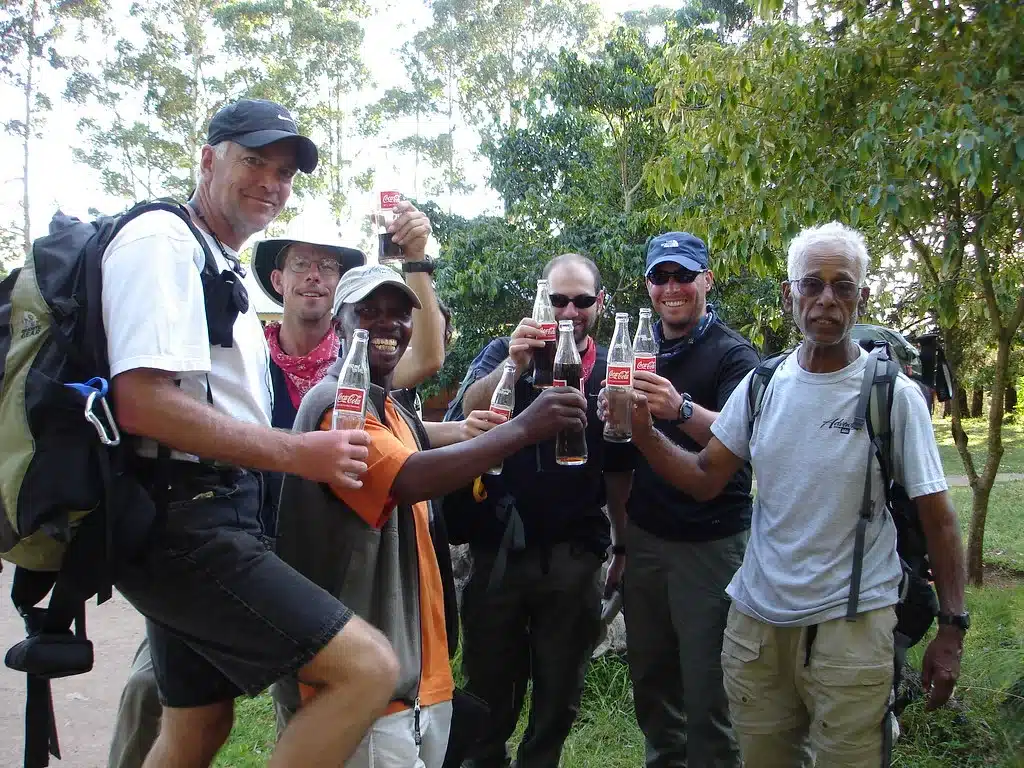
A Nostalgic Chapter: Let’s zoom in on that golden era. In the 1970s and 1980s, before strict park regulations limited commercialisation, hut rangers supplemented their income by stocking supplies. Coca-Cola, Sprite, and Fanta arrived by porter or occasional vehicle drops at Horombo (the midpoint hub). At Kibo Huts (4,700m), a warm Coke might cost a premium, but it was worth it for the psychological lift before summit night. Trekkers recall stories: “We’d stagger into Horombo after the long Day 2, and there’d be a ranger with a cooler—‘Coke? Only a few shillings! Candy bars like Cadbury or local equivalents fueled the final push. This wasn’t mass vending; it was enterprising locals making the route feel welcoming. Modern rules have curtailed it somewhat (no alcohol at high huts now, limited stock), but you can still buy bottled water, soft drinks, and snacks at all huts. The tradition lives on, and many operators joke, “Grab your Coke at Horombo—it’s part of the heritage!”This human touch—rangers as impromptu vendors—humanised the mountain and gave the route its soul.
Related: Can you drink alcohol on Kilimanjaro?
The Route’s Popularity: A Global Phenomenon Like the Coca-Cola Brand
Statistics tell the tale. In peak seasons (January-March, June-October), Marangu still sees thousands of climbers annually, though Machame and Lemosho have caught up due to better acclimatisation marketing. Historically, it was the route—up to 50-70% of all attempts pre-2000s. Why the enduring draw?
- Accessibility for Beginners and Time-Constrained Travelers: 5-6 days fits busy schedules. Huts mean less gear hassle.
- Perceived (and Real) Comfort: Showers at lower huts, flushing toilets, communal dining halls foster camaraderie—groups bond over shared meals and Coke toasts.
- Marketing Power: Agencies worldwide promote it as “the classic Coca-Cola Route,” evoking nostalgia and ease.
- Success Stories Spread: Despite challenges (more below), thousands summit yearly and rave about it on social media, TripAdvisor, and forums.
- Cultural Gateway: Starts in vibrant Marangu village, where Chagga hospitality shines—pre-trek banana beer tastings or cultural tours.
Like Coca-Cola’s global dominance through advertising, consistency, and emotional connection, the route’s popularity is self-reinforcing. It’s the “safe, fun” choice that draws families, first-timers, and corporate groups. In 2025-2026, data from operators show it remains in the top 3, especially for rainy seasons when huts keep you dry.
Why It’s Considered the Easiest Route – Exactly Like the Drink
“Easiest” is relative on a 5,895m mountain where altitude sickness kills dreams daily. But compared to others, Marangu shines:
- Terrain: Steady, non-technical gradients. No sheer walls or boulder-hopping until the final loose-scree summit push (shared by all routes).
- Accommodation: Huts vs. tents = warmer, drier, less setup time. Mattresses mean better sleep. Read about the Marangu Huts
- Duration and Profile: Shortest overall, with built-in gradual gain. 6-day version includes acclimatisation at Horombo.
- Logistics: Fewer porters (no tents/food for camping), potentially lower cost. Same path up/down means familiarity on descent.
It’s “easy” like Coca-Cola is the default drink—reliable, not intimidating, delivers quick satisfaction. But beware the myth: many unprepared climbers fail here precisely because they underestimate it. The rapid elevation gain (from 1,843m to 5,895m in days) tests the lungs and head. Success rates: 5-day ~50%, 6-day 70-90% with good operators (higher than some claim, per recent stats). Real ease comes from fitness, hydration, and “pole pole” (slowly slowly) pacing.
Related: Is it ok to drink coffee while climbing Mount Kilimanjaro, and what are the effects?
History of the Marangu Route
The story of the Coca-Cola Route begins not with fizzy drinks in the 20th century, but in the late 19th century with European exploration fever. Mount Kilimanjaro had long been a source of myth and wonder for outsiders. 19th-century missionaries like Johannes Rebmann reported snow on the equator in 1849, dismissed as fantasy by sceptics back in Europe. Enter Hans Meyer, a determined German geographer and professor born in 1858. Meyer became obsessed with conquering Africa’s rooftop. His first attempt in 1887 reached about 5,400 meters on Kibo but failed due to heavy snow and inadequate gear. A second try in 1888 also fell short. On his third expedition in 1889, everything aligned. Accompanied by Austrian alpinist Ludwig Purtscheller and a local Chagga guide named Yohane Kinyaha Lauwo (sometimes spelt Johannes or Lauwo), Meyer’s team approached from the southeast slopes—the exact path that evolved into today’s Marangu Route. On October 6, 1889—Purtscheller’s 40th birthday—they summited Kibo’s crater rim, becoming the first recorded Europeans (and documented group) to stand atop Uhuru Peak. Meyer later described the moment with awe, noting the vast crater, glaciers, and the feeling of standing on “the roof of Africa.”This wasn’t a random path. The Marangu area was (and remains) home to the Chagga people, who have lived on Kilimanjaro’s fertile lower slopes for centuries. Chagga oral traditions revere the mountain as a gift from Mulungu (or Ruwa), their supreme deity, who placed it there for protection and bountiful harvests. The Chagga developed intricate irrigation systems (mfongo) channelling glacial meltwater, turning the slopes into banana plantations and farms. Early porters and guides from Marangu villages knew the trails intimately, guiding hunters and traders long before Europeans arrived. By the early 20th century, under Germanand then British colonial rule, the Marangu Route became formalised. Huts were built in the 1930s-1950s by the Tanganyika government and later Tanzania National Parks. It quickly became the standard tourist route because of its gentle gradients, reliable water sources, and proximity to Moshi and the Marangu village gateway. For decades, it was virtually the only route most visitors considered. Today, a plaque at Marangu Gate honours Hans Meyer as “the first European explorer who conquered the summit of Mount Kilimanjaro in 1889.” Trekkers often pause to read it, feeling a direct connection to history. The route’s legacy as the “original” path adds profound meaning— you’re not just hiking; you’re retracing the footsteps of pioneers. Read more about Hans Meyer.
The Chagga connection runs deep. Many porters, guides, and cooks on the Coca-Cola Route hail from local Chagga families. Their knowledge of the mountain’s moods, weather patterns, and medicinal plants (like the giant lobelias) enriches every trek. Culturally, the route embodies harmony between humans and this volcanic giant.
Read also: Why the Machame Route is popularly called the “Whiskey Route”

