
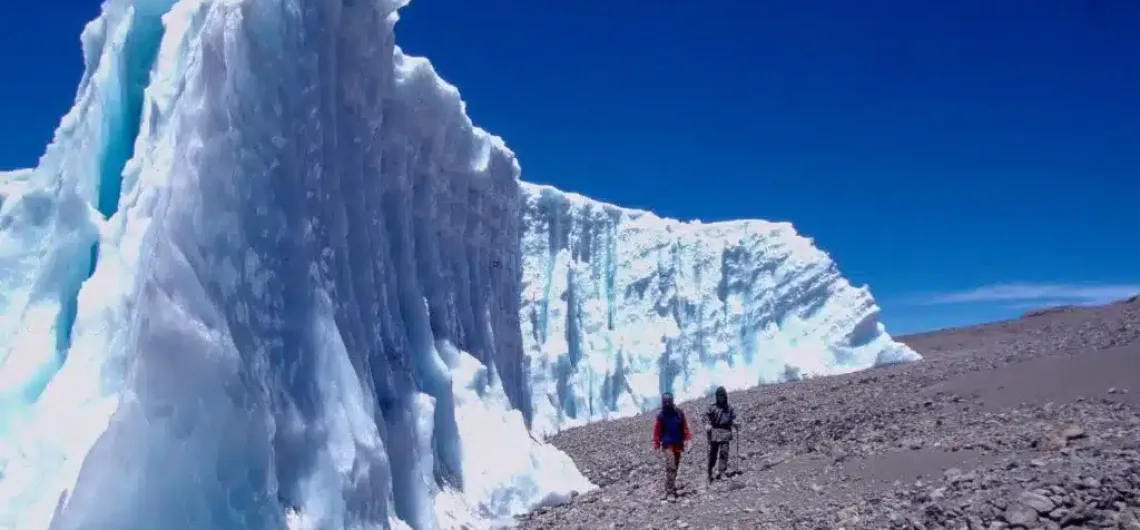
Over the years, there have been predictions and a growing trend of receding ice cover on Mount Kilimanjaro. Thanks to increased awareness and conservation efforts by tour operators and climbers, there is a glimmer of hope for the future of this world heritage site and Africa’s highest mountain. In a development that is quietly rewriting the story of one of the planet’s most celebrated mountains, fresh data from Tanzania’s Kilimanjaro National Park Authority (KINAPA) points to a substantial rebound in glacier coverage. According to the park’s GIS records, ice fields atop Mount Kilimanjaro have expanded from 2.24 square kilometres in 2010 to 5.92 square kilometres in 2025 — effectively almost tripling since the low point around 2.2 square kilometres recorded in 2000. Grade One Conservation Officer Swahibu Massawe of KINAPA’s Ecology Conservation Science Unit described the change as “a significant turnaround” for the world’s tallest free-standing mountain. He made the remarks on 23 March 2026 while addressing a send-off ceremony for 22 staff members from the Tanzania Unit Trust Fund (UTT) and the National Development Corporation, who were about to embark on a six-day climb.
From Sharp Decline to Measured Recovery
For most of the late 20th century, the narrative around Kilimanjaro was one of relentless loss. Between the 1980s and 2000, climate change combined with deforestation on the mountain’s lower slopes caused a steep drop in ice cover. NASA-cited research shows that more than 80% of the glacier area present in 1912 had disappeared by 2011, cementing the mountain’s status as a visible symbol of global warming. In 2000, the Tanzanian government, working with TANAPA, launched deliberate interventions to improve moisture retention. Large-scale reforestation programs, soil-stabilization projects, and closer collaboration with surrounding communities were rolled out across the foothills. The goal was straightforward: restore vegetation to raise local humidity, reduce erosion, and create conditions that allow more snow to accumulate and persist at higher elevations. Mr Massawe credits these sustained partnerships with the visible recovery that began registering around 2010. He also highlighted a welcome shift in research capacity: where once 90% of glacier studies were conducted by foreign scientists, Tanzanian researchers are now playing a growing role in monitoring and interpreting changes on their own mountain.
Tourism Boom Coincides with Greener Slopes
The environmental gains are arriving at the same time as record visitor numbers. KINAPA Chief Conservator (and Senior Assistant Conservation Commissioner) Angela Nyaki confirmed that climber totals rose from more than 60,000 in the 2023/2024 season to over 69,000 in 2024/2025. Revenue followed suit, climbing from TZS 95 billion to approximately TZS 103 billion (roughly US $40 million). Domestic tourism has contributed noticeably to the increase, broadening the mountain’s appeal beyond international adventure seekers. Tour operators report a subtle but important change in marketing tone. The long-dominant “see it before it’s gone” narrative is giving way to one centred on visible environmental recovery — an angle that resonates strongly with conservation-conscious travellers.
A Mountain of All Ecosystems
At 5,895 metres, Kilimanjaro is unique in compressing virtually every terrestrial ecosystem into a single vertical transect: lush rainforests, montane bushland, savannah grasslands, semi-arid desert-like zones, and the permanent ice fields at the summit, often described locally as “an arctic in the tropics.” This extraordinary biodiversity makes the glacier story more than a curiosity; it is a litmus test for how well holistic conservation can protect an entire landscape.
Caution from the Scientific Community
While the KINAPA figures are striking, they remain preliminary and have not yet been independently verified or published in a peer-reviewed journal. Climate scientists not involved in the data collection have urged scrutiny. One researcher described the reported growth as “an extraordinary shift” but added the classic caveat: “extraordinary claims require extraordinary verification.”Experts note several important caveats:
- Surface-area measurements alone do not reveal ice volume; a glacier can spread laterally while continuing to thin.
- Short-term weather variability — including periods of heavier snowfall — can produce temporary gains that do not necessarily signal long-term recovery.
- Differences in methodology (satellite imagery, aerial photography, or ground surveys) and the challenge of distinguishing permanent glacier ice from seasonal snow can affect reported boundaries.
The new data also sit at odds with the wider scientific consensus. Studies published as recently as 2025 continue to document retreat across Africa’s tropical glaciers, and the United Nations has warned that the ice on Kilimanjaro, Mount Kenya, and the Rwenzori range could disappear entirely by 2050 under current warming trajectories.
More Than a Scientific Debate
Regardless of how the numbers are ultimately verified, the discussion carries real-world weight. Kilimanjaro’s glaciers are intimately tied to Tanzania’s tourism economy and the livelihoods of communities living around the park. The revenue generated helps fund further conservation, anti-poaching efforts, and community development projects — creating a virtuous circle when the mountain’s image remains strong. For now, the data should be treated with the caution that any unexpected environmental signal deserves. Whether the observed increase is a genuine, sustained rebound driven by local stewardship or partly the result of measurement differences and short-term climatic fluctuations will require additional independent studies using consistent volume-tracking methods. What is already clear is that Mount Kilimanjaro continues to surprise. Even the world’s most iconic climate indicators can still defy simple predictions — reminding scientists, policymakers, and visitors alike that careful, ongoing scrutiny and committed local action remain essential. In an era when glacier retreat dominates headlines, Kilimanjaro’s reported renaissance offers a hopeful reminder that conservation partnerships, when sustained over decades, can sometimes shift the trajectory of even the most vulnerable landscapes.
Related articles
- The vanishing glaciers of Mount Kenya and the disappearing Lewis Glacier
- The melting glaciers of the Himalayas mountain ranges wrecking havoc in accelerating Pakistan floods
- Kilimanjaro’s glaciers shrink as scientists warn Africa’s highest mountain may soon be ice free
- Thomas Glacier Route – a new route on Kilimanjaro
- Does Africa get snow?
- Snow-capped Kilimanjaro, flying safari rally car and amazed Maasai in Kenya, the story of the legendary WRC photo
- Why is Mount Kilimanjaro covered with snow at the summit?
- Do you need crampons, ice axes and spikes to climb Mount Kenya and Rwenzori?
- Mount Everest cornice collapse, overcrowded long queues, filthy base camp conditions, thick traffic jams in the spotlight
Read more about the Glaciers of Kilimanjaro below.
- Furtwängler Glacier
- Credner Glacier
- Balleto Glacier
- Heim Glacier and Kersten & Decken Glaciers
- Arrow Glacier & Drygalsky Glacier
- Rebmann Glacier & Ratzel Glacier

