
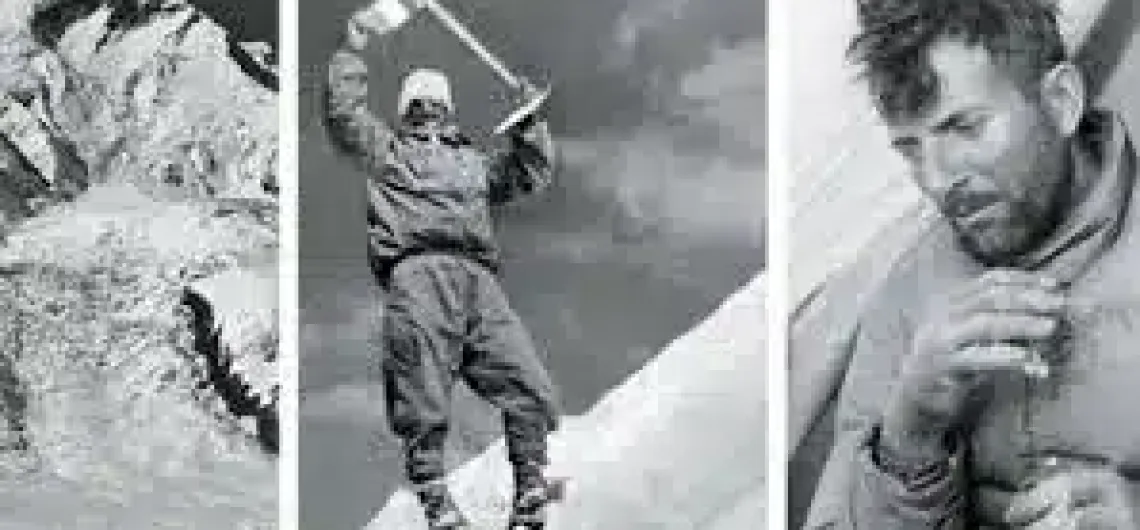
Becoming the first man on the peak of an eight-thousander is phenomenal, in the world of the firsts and record breakers. In the crisp dawn of June 3, 1950, about 76 years ago, two Frenchmen stood alone on the roof of the world—or at least what felt like it at the time. Maurice Herzog and Louis Lachenal had just reached the summit of Annapurna I, an 8,091-meter giant in the Nepalese Himalayas. No one had ever climbed an 8,000-meter peak before. Not Everest, not K2, not any of the fourteen giants that now define high-altitude mountaineering. This was the first. And it came at a staggering cost: frostbite, amputations, a desperate retreat, and a story that would inspire generations while sparking decades of debate. This is the tale of the 1950 French Annapurna Expedition—not just the climb itself, but the men behind it, the improbable route they forged, and the human drama that unfolded in one of the most remote corners of the planet.
Who Were Maurice Herzog and Louis Lachenal?
Maurice Herzog was born in Lyon, France, in 1919, the eldest of eight children in a family that already cherished the Alps. A talented amateur climber with a background in business studies and wartime service in the French Resistance, Herzog embodied the post-war French spirit: resilient, ambitious, and eager to reclaim national glory after years of occupation and hardship. At 31, he was chosen to lead the expedition by Lucien Devies, the powerhouse behind French mountaineering. Herzog wasn’t the most technically gifted climber on the team, but he was a natural leader—charismatic, idealistic, and driven by a vision of France standing tall once more.
His summit partner, Louis Lachenal, was cut from a different cloth. Born in 1921 in Annecy, Lachenal was a professional Chamonix mountain guide—a “man of the rope,” as the French say. Lean, lightning-fast, and supremely skilled on loose or delicate terrain, he had already made history in the Alps with regular partner Lionel Terray. Together they had blazed up the Walker Spur on the Grandes Jorasses and the North Face of the Eiger. Lachenal climbed for the pure joy of it and the livelihood it provided. He had no illusions about glory; he knew exactly what a few frozen toes could mean for a guide’s career. The rest of the team was a powerhouse: Terray and Gaston Rébuffat (fellow Chamonix guides), Jean Couzy and Marcel Schatz (strong amateurs), expedition doctor Jacques Oudot, photographer Marcel Ichac, and the legendary Sherpa sirdar Ang Tharkay. They were united by one goal: to be the first to stand on an 8,000-meter summit.
 A Nation Hungry for Victory: Planning the 1950 Expedition
 A Nation Hungry for Victory: Planning the 1950 Expedition
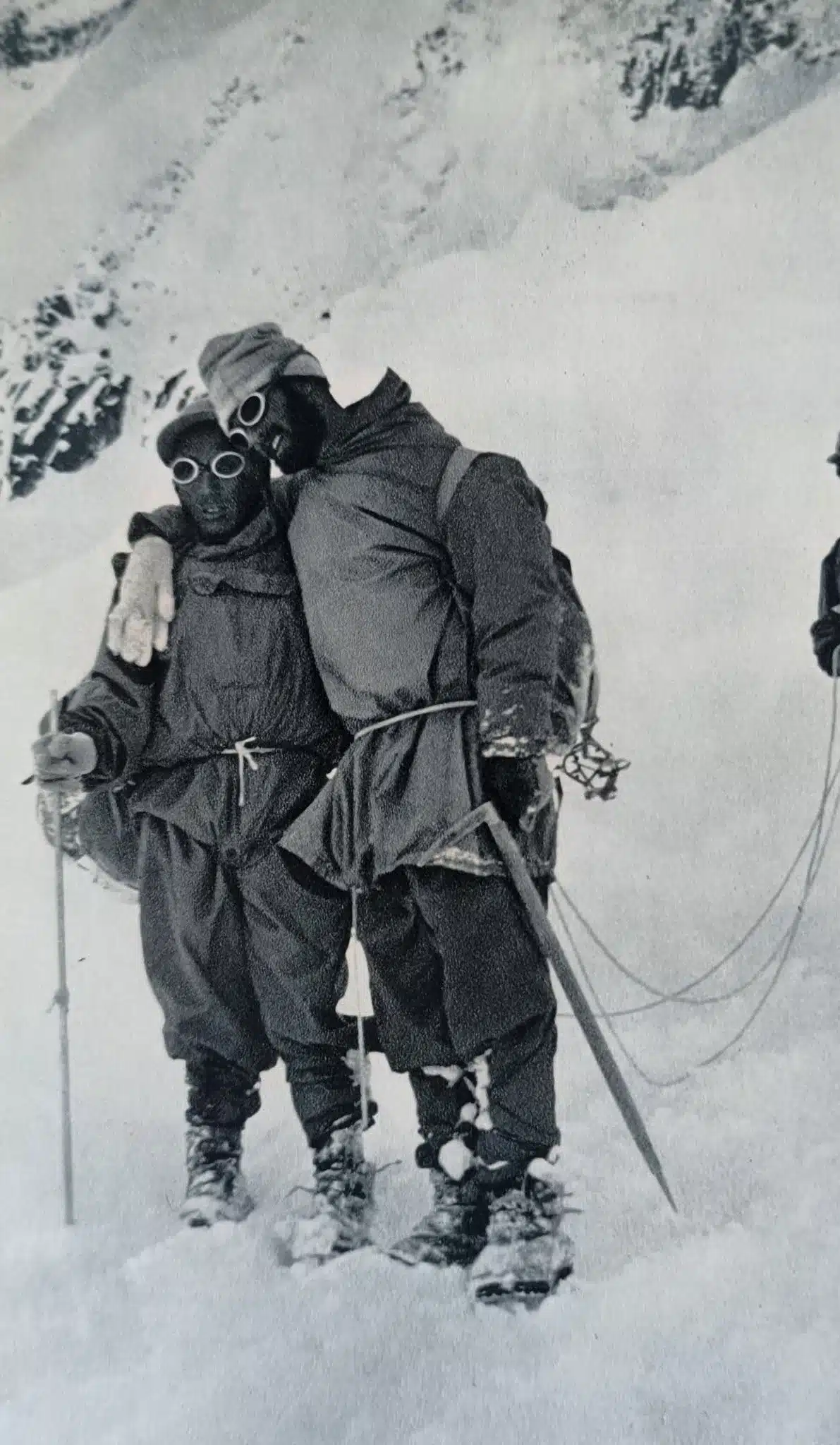
After World War II, the world of Himalayan climbing had been turned upside down. Tibet closed its borders, and Nepal—long isolated under the Rana dynasty—finally cracked the door open to foreigners in 1949. The French Alpine Club seized the moment, securing permission to attempt either Dhaulagiri or Annapurna in northwest Nepal. No one had ever properly mapped or reconnoitered these peaks. The team would have to explore, climb, and summit in a single season before the monsoon arrived. They flew to India in late March 1950 with three and a half tons of cutting-edge gear: nylon ropes, down-filled jackets, and innovative felt-lined boots. No bottled oxygen. Food would be bought locally. Herzog swore the team to absolute obedience just days before departure. They marched in through the Kali Gandaki valley with 150 porters, Lachenal and Terray scouting ahead like eager wolves.
The Great Reconnaissance: Finding the Mountain
Dhaulagiri rose first—a white pyramid that left the team speechless. They spent two weeks probing its ridges and glaciers, only to declare every route “fiendishly difficult” or worse. A Buddhist monk in Tukucha village offered cryptic advice: “Dhaulagiri is not propitious to you.” Herzog listened. They turned their eyes eastward to Annapurna. But Annapurna was hidden behind the Nilgiri mountains and a “Great Barrier” of unmapped peaks. Faulty 1920s British survey maps showed phantom paths and passes. The team split into small groups, pushing through gorges, over frozen lakes, and across ridges. They discovered Tilicho Lake and the hidden valleys, corrected maps on the fly, and finally—after weeks of frustration—descended the Miristi Khola gorge to stare up at Annapurna’s vast north face.
It was May 14. The monsoon was due in early June. Time was running out.
The Route: A High-Stakes Gamble on the North Face
Most of the team had expected a ridge climb. Instead, they committed to the broad, avalanche-prone north face. Lachenal and Rébuffat spotted a promising line up the glacier to a high plateau. Herzog and Terray confirmed from above that the plateau led to the summit without impossible barriers. Base Camp was established at the foot of the glacier. Then the camps went up with astonishing speed: Camp I on the glacier, Camp II on the plateau, Camp III among seracs, and Camp IV beneath a curving ice cliff they nicknamed “the Sickle.” The team moved like a well-oiled machine, carrying loads in brutal conditions, sometimes fueled by the expedition doctor’s stimulant Maxiton. By May 28, they had Camp IV at 7,150 meters. On June 2, Herzog, Lachenal, and Sherpa Ang Tharkay reached the assault camp at 7,400 meters. Ang Tharkay, a veteran of pre-war Everest expeditions, was offered a summit spot. His reply was pure mountain wisdom: “Thank you, Bara Sahib, but my feet are beginning to freeze, and I prefer to go down.”
 Summit Day: June 3, 1950
 Summit Day: June 3, 1950
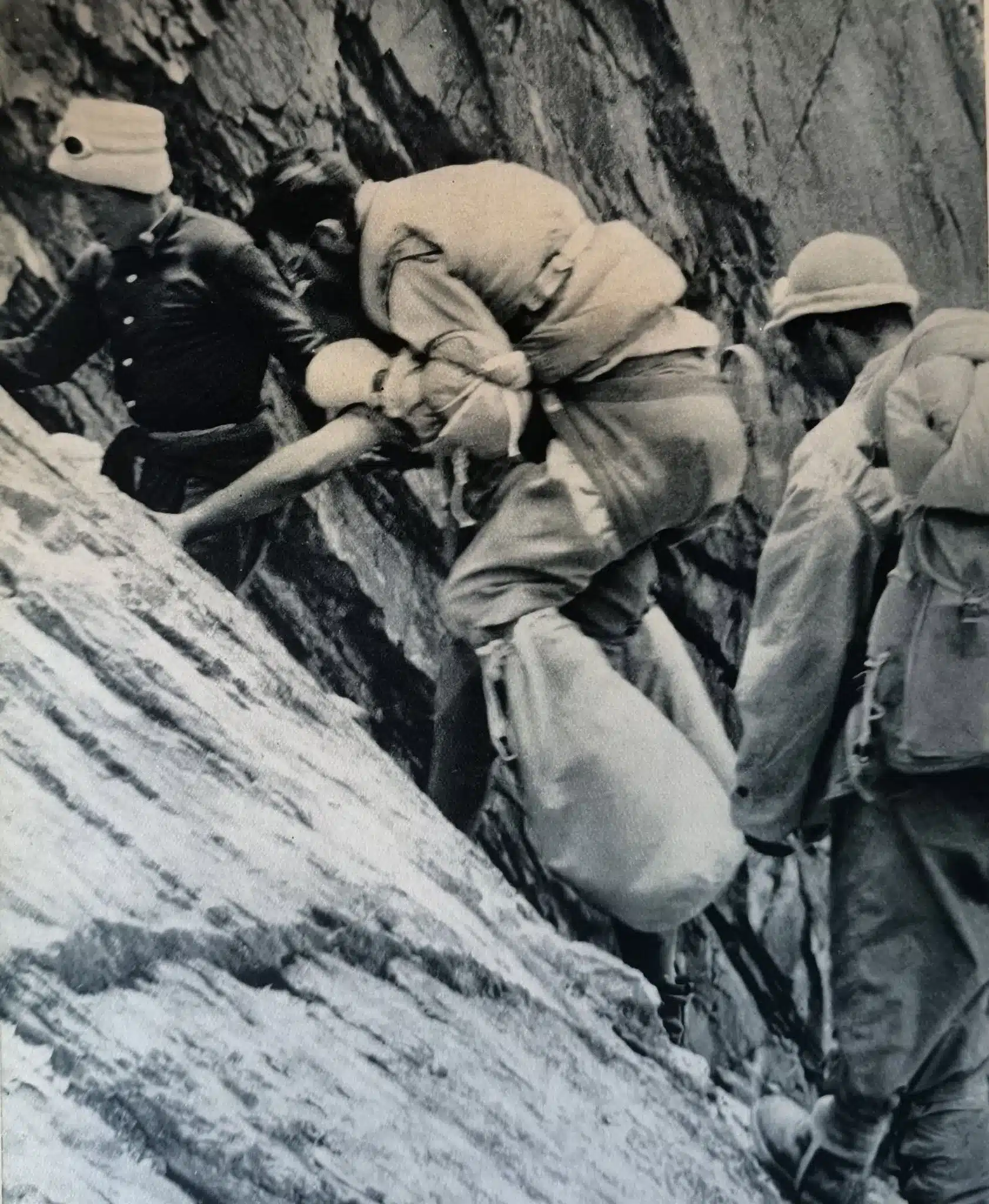
The final push began at dawn in gale-force winds. Neither man had slept or eaten properly—high altitude had dulled their judgment. Lachenal’s feet were already numb. Halfway up, he asked Herzog, “If I go back, what will you do?” Herzog, riding a wave of euphoria (later attributed partly to the stimulants), replied he would continue alone. Lachenal chose to stay. They topped out at 2 p.m. Herzog planted the Tricolor and a sponsor’s pennant. Lachenal felt only emptiness. They spent barely an hour on top before racing down as clouds closed in.
The Descent: A Nightmare of Frostbite and Survival
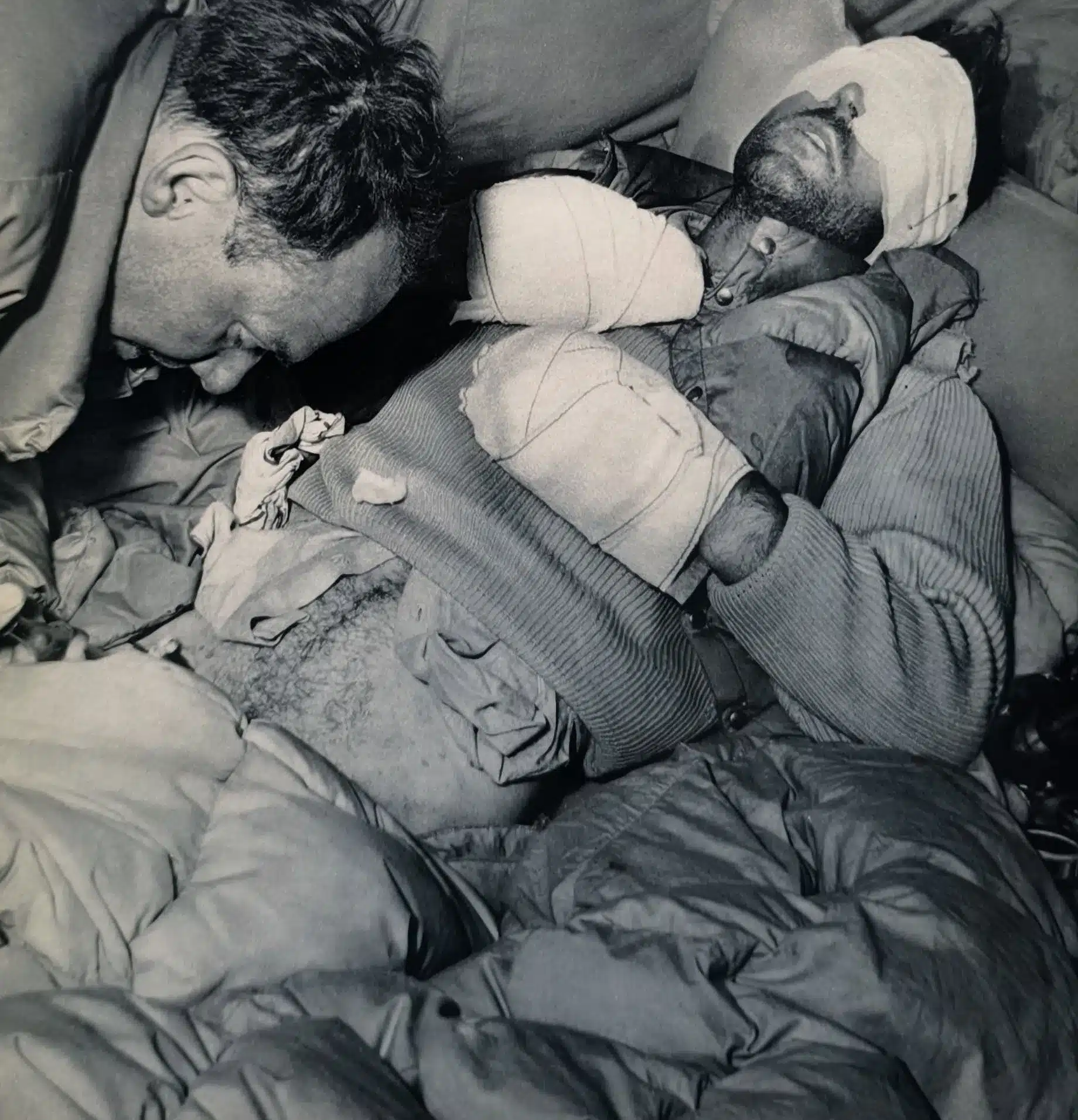
Disaster struck almost immediately. Herzog removed his gloves to rummage in his pack; they slid away forever. Bare-handed in the gathering storm, he trailed Lachenal. At Camp V, they met Terray and Rébuffat, who had been preparing their own summit bid. The pair was horrified by Herzog’s icicle-like hands. Lachenal had fallen below camp, losing his ice axe and a crampon. Terray hauled him back. That night, in two tiny tents, Terray and Rébuffat massaged the frostbitten extremities of their friends for hours. The next morning, the storm raged. Boots wouldn’t fit. They descended blind—Terray and Rébuffat snow-blind, Herzog and Lachenal hobbling on ruined feet. They bivouacked in a crevasse, four men sharing one sleeping bag as snow poured in. Cameras (including the summit photos) were lost. An avalanche later swept Herzog and two Sherpas 150 meters down the slope. Miraculously, the rope held. Back at Base Camp, Dr. Oudot began administering arterial injections to restore circulation. The pain was indescribable. As they retreated across Nepal—crossing swollen rivers, building makeshift bridges, and dodging the monsoon—the doctor performed field amputations. Herzog lost all his fingers and toes. Lachenal lost all his toes.
 Aftermath: Glory, Controversy, and Legacy
 Aftermath: Glory, Controversy, and Legacy
The team reached India by train. Herzog dictated his book Annapurna from a hospital bed in France. It sold over 11 million copies worldwide and became the best-selling mountaineering book ever. Paris Match ran special editions. Herzog was hailed a national hero, awarded the Légion d’Honneur, and later became France’s Minister for Youth and Sport, Mayor of Chamonix, and a long-serving Olympic official. He never regretted the climb. Lachenal’s story was quieter. His unedited diaries, published decades later, revealed tensions. He felt Herzog had painted him as hesitant when in reality he had simply been pragmatic. Some teammates questioned Herzog’s version of events, suggesting the official account emphasized national glory at the expense of full honesty. Lionel Terray later wondered in his own book whether the price had been worth it. Gaston Rébuffat was more blunt. Yet the achievement stands unchallenged. Annapurna was climbed in one season, without oxygen, on the first serious attempt, after weeks of exploration in unmapped terrain. It captured the world’s imagination and opened the floodgates for the golden age of 8,000-meter climbing. Herzog lived until 2012, still revered in France. Lachenal died in 1955 after falling into a crevasse while skiing—another cruel twist of fate. Their partnership on Annapurna remains one of mountaineering’s most poignant: one man’s idealism meeting another’s hard-earned realism, both forever bound by rope, frost, and history. Today, when we look at modern expeditions with satellite phones, fixed ropes, and helicopters on standby, it’s easy to forget how raw and reckless the 1950 ascent truly was. But that’s what made it legendary. As Herzog himself wrote in the book’s famous closing line: “There are other Annapurnas in the lives of men.”The first 8,000-meter peak had been climbed. The age of the eight-thousanders had begun. And it began with two exhausted Frenchmen, a storm-lashed mountain, and a courage that still takes the breath away.
You may be interested in.
- Reinhold Messner, first human to summit Everest solo without supplemental oxygen
- How Lenka Poláčková, the First Slovak Woman to Climb K2 and Everest Without Oxygen, Conquered Kilimanjaro with Tranquil Kilimanjaro
- Youngest person to summit Kilimanjaro and Mount Kenya
- Sir Edmund Hillary and Tenzing Norgay, the first persons to climb to the summit of Mount Everest
- First timer climbing Kilimanjaro, which route is best for beginners?
- The first ascent of Jannu East by French duo of Benjamin Védrines and Nicolas Jean
- Doug Scott Tribute: The first Englishman to summit Mount Everest
- Tenzing Norgay, the first sherpa to summit Mt. Everest
- Michael Groom, the first Australian to climb Kangchenjunga, world’s third highest mountain and 1996 Everest tragedy survivor
- Frank Smythe – The first professional mountaineer’s secret from 1936 Everest Expedition
- James Kagambi 62, the first Kenyan to summit Mt Everest with the first all black team
- Sheikha Asma Al Thani, First Qatari Woman to Summit the Everest
- Assault on Everest: How rich nations assembled massive assaults on Everest to reach the top first.
- David Breashears, 68, who transmitted the first live pictures from the summit of Mount Everest in 1983, Dies
- Remembering Richard Bass, first person to climb highest peak on each continent
- How Stella Point was named after Estella Latham, the first woman to reach this point
- Pasang Lhamu Sherpa Akita: The First Female Nepali Mountaineering Guide
- WANDA RUTKIEWICZ – First woman to summit K2 and first European woman to climb Everest – The first Polish citizen to climb Mount Everest and K2
- Al Rouse: the first British climber to reach the summit of the second highest mountain in the world, K2
- Hermann Buhl, the first person to summit of Nanga Parbat, the ninth highest mountain in the world
- Was Hans Meyer the first person to climb Mount Kilimanjaro to the summit?
- George Mallory: Was he the first person to climb Mount Everest?
- Prof. Fritz Jaeger, the first recorded person to summit Mount Meru
- Lino Lacedelli Dies at 83; One of First persons to Scale K2
- Johann Ludwig Krapf the first European person to see Mount Kenya
- Anne Lorimor, 89 becomes the oldest person to climb Mount Kilimanjaro
- How 5 year old, Ognjen Živković became the youngest person to climb Kilimanjaro against all odds

