
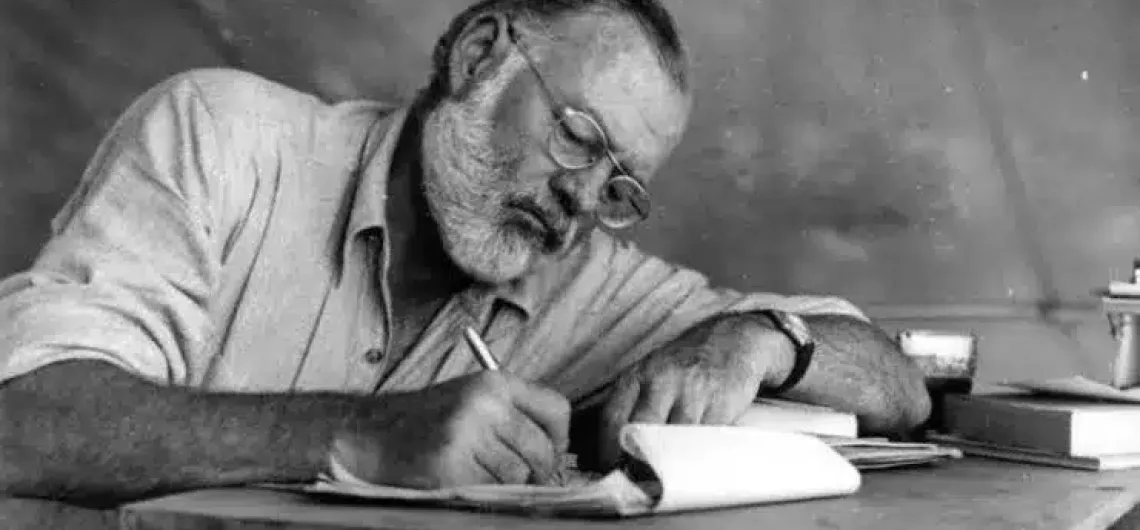
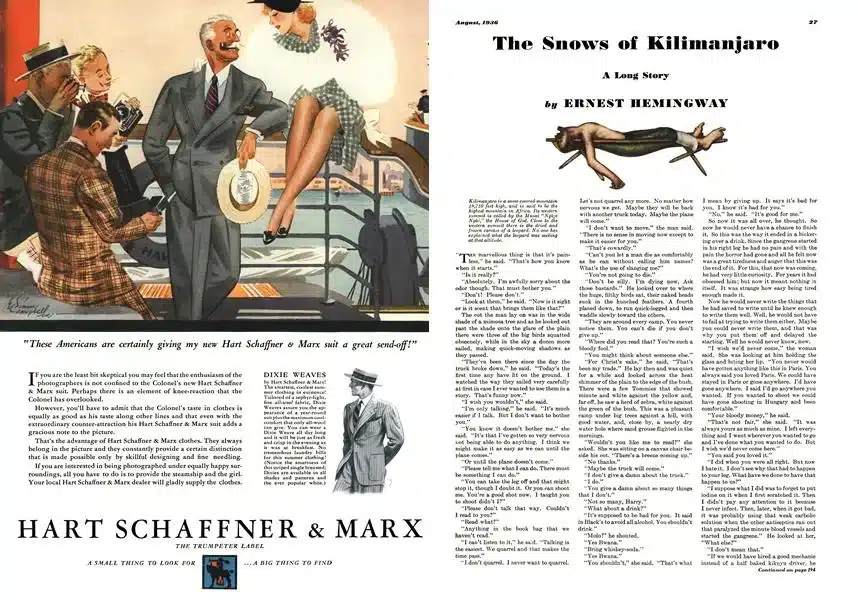
The Snows of Kilimanjaro turns 90, on August 1st, 2026, since it was completed by Ernest Hemingway and published in Esquire Magazine.
There is a mountain in East Africa whose western summit the local people call the House of God. Near its frozen peak lies the carcass of a leopard. No one has explained what the animal sought at that impossible height. That single, unexplained fact opens Ernest Hemingway’s 1936 story “The Snows of Kilimanjaro” and shadows everything that follows.
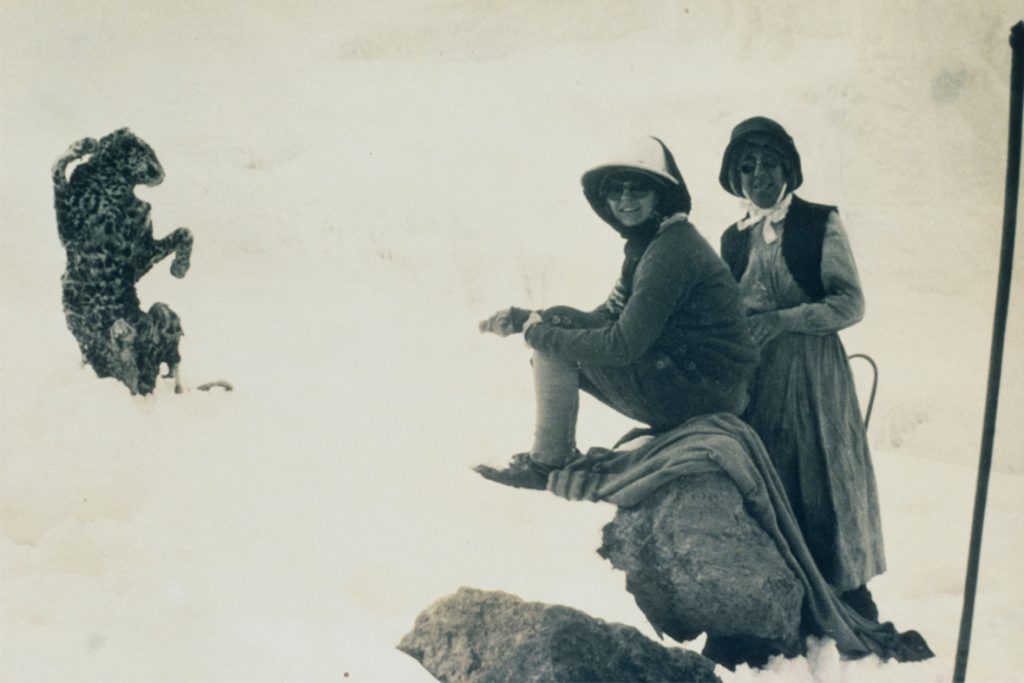
You can read about the discovery of the frozen leopard on Kilimanjaro below.
The amazing story of Pastor Reusch, a frozen leopard on Kilimanjaro that inspired Ernest Hemingway
The story is not about the mountain. It is about Harry, a writer dying of gangrene on the hot African plain below it.
The plot and themes
A trivial thorn scratch, neglected while photographing a waterbuck, has turned septic. Harry lies on a cot in a broken-down safari camp, waiting for a plane that may arrive too late. His wealthy wife, Helen, tends him; he responds with cruelty. He tells her he never loved her and blames her money for softening him, for letting him abandon the hard work of writing. In truth, he knows the failure is his own. He chose comfort over the discipline his gift required. The flashbacks form the real heart of the story. They arrive without warning, triggered by a sound or a silence. Harry recalls skiing in the Austrian Alps on a bright Christmas morning during the war, a deserter with bloody feet, the poor quarter in Paris where he once wrote well, quarrels with women, a burned hunting cabin, and the night he turned in a simple-minded boy who had shot a thief. These are not nostalgic fragments. They are the precise, unsentimental material of the books he never wrote. He sees them clearly now, when it is too late. The contrast is merciless. In memory, he was cold, hungry, frightened, and alive. On the plain, he is warm, well-fed, and rotting from within. The gangrene is both physical and moral: comfort has done to his talent exactly what the infection is doing to his leg. Helen, who survived her own losses and rebuilt a life, stands for the safety that has undone him. The story grants her no easy villainy and grants Harry no easy excuse. Death appears as a hyena. It circles the camp at night with its ugly, persistent cry. Later, Harry feels its weight on his chest and its breath on his face. Unlike the mysterious leopard of the epigraph, the hyena is patient, ugly, and inevitable.
In his final vision—or final clarity—Harry is lifted onto a plane. The pilot flies him through the storm into clear air. There, wide as all the world, rises the square white summit of Kilimanjaro. Harry knows this is where he is going. When Helen wakes at dawn, the hyena has fled. Harry is dead. The rescue plane arrives too late for his body, but the dream has carried something else: the part of him that still wanted to write everything. The ending remains ambiguous. Redemption, self-deception, or the cold fact that only death restores what life corrupted? Hemingway refuses to decide. The mountain stays; the leopard’s purpose stays unexplained. What matters is that Harry finally sees the height he never reached while alive. Hemingway’s restraint gives the story its force. Almost everything essential lies beneath the sparse dialogue, in the weight of the flashbacks. A single memory stands out: Harry once gave all his morphine to a comrade named Williamson whose wounds caused unbearable pain. Now, numbed by gangrene, Harry feels a grim relief that he will not suffer the same way. The story returns to a theme Hemingway explored in “The Short Happy Life of Francis Macomber,” another African tale from the same year. Wealth and safety can erode something essential in a man until death forces a reckoning. Macomber finds a fierce, brief courage. Harry finds only regret and a last, hallucinatory glimpse of purity. Harry’s real tragedy is not death itself but dying without having used what he was given. The experiences he kept in memory instead of shaping them into prose are lost. The mountain stands as both rebuke and promise: there is still a height worth climbing, even if most people remain on the plain.
Adaptations
The most prominent adaptation is the 1952 Hollywood film directed by Henry King and starring Gregory Peck as Harry, Susan Hayward as Helen, and Ava Gardner as a former lover. The screenplay by Casey Robinson significantly expands the story with flashbacks drawn from other Hemingway works and adds new characters and subplots. The film’s most striking departure is its ending. Instead of Harry’s peaceful death and ambiguous vision, the movie delivers a conventional happy resolution: Harry survives, reconciles with Helen, and is inspired to resume writing. Hemingway disliked the changes. He accepted the payment for the rights but reportedly never watched the film and referred to it dismissively as “The Snows of Zanuck,” alluding to producer Darryl F. Zanuck. He later joked that the best performance came from a hyena. No other major film or television adaptations have achieved the same cultural impact. The 1952 version remains the best-known attempt to bring the story to the screen, though many readers and critics consider it a dilution of the original’s restraint and ambiguity.
Sir Chris Bonington, the man, the myth the legend
The Protagonist
Harry is a once-promising writer who has allowed comfort and success to erode his talent. He is intelligent, self-aware, and bitterly honest with himself, even as he lashes out at Helen. Through the flashbacks, we see the man he once was: adventurous, observant, and capable of turning raw experience into precise prose. His relationship with Helen is central and complex. He resents the security her wealth provides, yet he also recognizes that she has endured real tragedies and rebuilt her life with dignity. Harry’s cruelty toward her is partly projection; he knows he is the one who has failed to live up to his own standards. Even as he dies, Harry continues to measure himself against others. The memory of giving morphine to the mortally wounded Williamson reveals both his compassion and his quiet pride in facing death with less agony than his comrade endured. Harry is not a heroic figure in the conventional sense. He is a man who sees clearly what he has lost and what he will never accomplish.
20 Recommended books for Kilimanjaro, the best reading list.
The Inspiration
Hemingway drew directly from his own 1933–1934 African safari with his second wife, Pauline. The landscape, the camp life, the tension between luxury and hardship, and even the medical emergency (Hemingway contracted severe dysentery and required evacuation by plane) all fed into the story. More deeply, the story reflects Hemingway’s private fears at the height of his early success. Fame and marriage to a wealthy woman had brought money and social ease. He worried that comfort might blunt the edge required for serious writing—the same fear that torments Harry. The flashbacks echo experiences from Hemingway’s own life: war, Paris in the 1920s, skiing in the Alps, and the constant pressure to turn lived experience into lasting work. While Harry is not a direct self-portrait, the story functions as a warning Hemingway wrote to himself about the dangers of squandered talent and the seduction of an easier life.
The Real Mount Kilimanjaro
Mount Kilimanjaro is Africa’s highest peak, rising 5,895 meters (19,341 feet) on the border of Tanzania and Kenya. It is a dormant volcano with three main peaks; the western summit, Kibo, is the one referred to in the story. The Maasai people have long called this western summit “Ngaje Ngai,” or the House of God. The frozen leopard of the epigraph is based on real historical reports. In the 1920s, climbers and a Lutheran missionary named Richard Reusch documented mummified leopard remains at approximately 5,640 meters (around 18,500 feet) on the mountain’s upper slopes. The body was remarkably well preserved by the freezing conditions. A photograph from 1926 shows the curled, desiccated carcass. How and why the leopard climbed so far above its normal hunting range remains unknown—possibly in pursuit of prey or through disorientation. In the story, the mountain and the leopard represent purity, aspiration, and an unattainable ideal. The snows stand in stark contrast to the rotting plain where Harry lies dying. Hemingway uses the real geographical and legendary elements of Kilimanjaro to create a powerful symbol of what Harry has failed to reach in life: clarity, achievement, and perhaps a form of redemption visible only at the moment of death. The snows remain on Kilimanjaro, white and untouched. Hemingway’s story does not explain what the leopard sought there. It only shows what happens to the person who never tries to find out.
Ernest Hemingway’s African Safaris: Adventure, Writing, and Near-Death
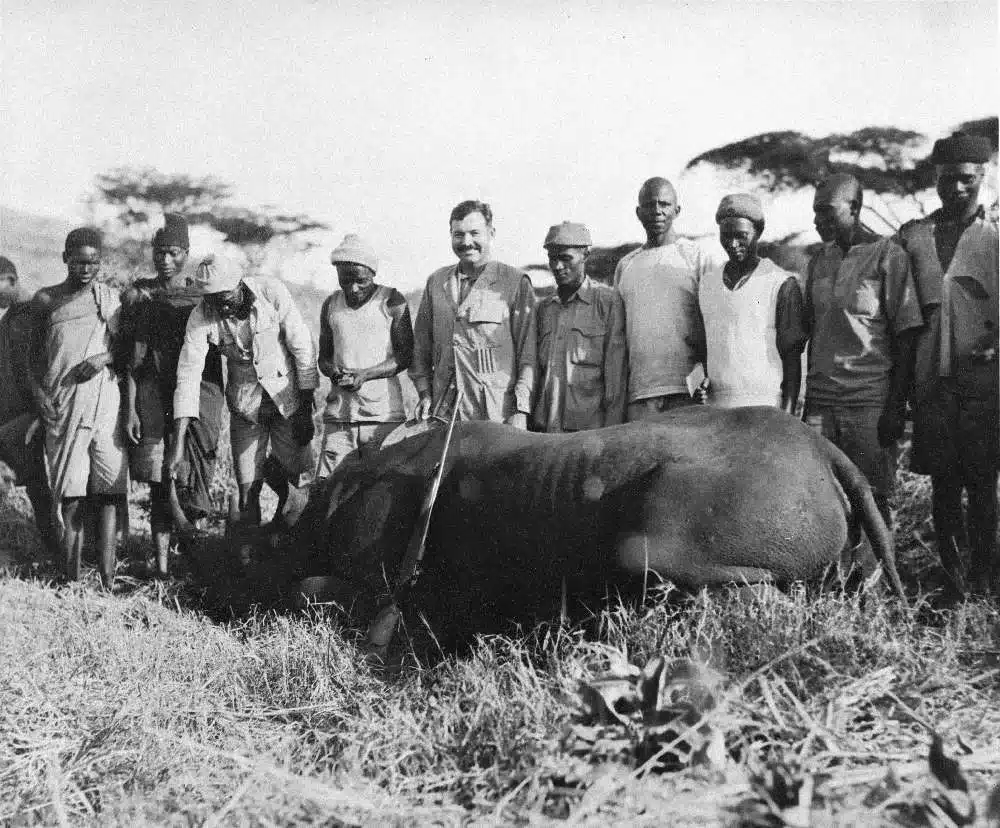
Ernest Hemingway’s two major African safaris—separated by two decades—represent some of the most vivid expressions of his lifelong pursuit of danger, authenticity, and raw experience. Africa offered him a vast stage for big-game hunting, masculine testing, and literary inspiration, while also delivering profound personal consequences. These trips directly shaped key works, including the nonfiction Green Hills of Africa (1935) and the short stories “The Snows of Kilimanjaro” (1936) and “The Short Happy Life of Francis Macomber” (1936).
Would you want to visit Tanzania for an African safari? Click here to see our tours.
The First Safari: 1933–1934
Fresh from the success of novels like A Farewell to Arms (1929), the 34-year-old Hemingway sought new frontiers. In November 1933, he and his second wife, Pauline Pfeiffer, sailed from Marseilles. They arrived in Mombasa, Kenya, in early December and spent roughly three months (primarily December 1933 to February 1934) hunting in what was then Tanganyika Territory (modern-day Tanzania), with stops in Kenya. The safari was luxurious and well-funded—reportedly costing around $25,000 (a significant sum then), partly as a gift from Pauline’s wealthy uncle. Key companions included:
- Pauline (nicknamed “P.O.M.” or “Poor Old Mama” in his writing).
- Hemingway’s Key West friend Charles Thompson (called “Karl” in the book).
- Legendary professional hunter Philip Percival (“Pop”), who had guided Theodore Roosevelt decades earlier.
- Austrian expatriate Hans Koritschoner (“Kandisky”), who sparked literary conversations.
Hemingway hunted kudu, rhino, lion, buffalo, and other big game with intense competitiveness—especially with Thompson. Days involved tracking in the Serengeti, around Lake Manyara, and other areas. He hired African staff, including gunbearer M’Cola, and documented the landscape with genuine awe for its beauty and wildlife. A major health crisis struck in mid-January 1934: Hemingway contracted amoebic dysentery, leading to a prolapsed intestine. He was evacuated by plane to Arusha and then Nairobi for treatment before rejoining the group. This brush with mortality later echoed in his fiction.
Literary fruit: The trip produced Green Hills of Africa, Hemingway’s second nonfiction book. He aimed for an “absolutely true” account that could rival fiction in artistic quality. The book blends hunting narratives, camp life, competitive tension (especially his jealousy of Thompson’s bigger kills), and extended discussions on writing and literature (praising writers like Tolstoy, Flaubert, and Mark Twain). It is structured in four parts—“Pursuit and Conversation,” “Pursuit Remembered,” “Pursuit and Failure,” and “Pursuit as Happiness”—and was serialized in Scribner’s Magazine. Reception was mixed; some praised its vivid hunting scenes and landscape descriptions, while others found the dialogue stylized and the self-focus excessive. Hemingway was stung by criticism but channeled the energy into new fiction. The safari also directly inspired his two greatest African short stories:
- “The Short Happy Life of Francis Macomber”: Explores cowardice, courage, and redemption during a lion hunt. Macomber’s arc reflects Hemingway’s interest in the “code hero” who faces death squarely.
- “The Snows of Kilimanjaro”: A dying writer on safari regrets his wasted talent. The gangrene from a neglected thorn scratch parallels Hemingway’s real dysentery (and the plane evacuation in the story mirrors his own medical flight). The story’s famous ending vision of the snow-capped mountain draws on the landscape he experienced.
The Second Safari: 1953–1954
Hemingway hoped to recapture the magic of the first trip. In 1953, he and his fourth wife, Mary Welsh Hemingway, returned for what became a nearly seven-month stay, primarily in Kenya. Look magazine funded much of it ($15,000 for photos/captions plus $10,000 for an article) to promote tourism. Philip Percival guided them again. Hemingway was even made an honorary game warden. The trip began with high hopes—hunting, photography, and adventure. Mary struggled more with the killing aspect than Ernest, and later adopted an orphaned gazelle. The couple engaged in playful gender-role experiments documented in their journals (later influencing the posthumous novel The Garden of Eden). Tragedy struck in January 1954 near Murchison Falls (in what was then the Belgian Congo/Uganda border area). Hemingway chartered a sightseeing flight over the falls as a Christmas gift to Mary. The small plane struck a telegraph wire/utility pole and crash-landed in the bush near elephants and crocodiles. Mary suffered cracked ribs; Hemingway had back and shoulder injuries. They spent a cold night in the brush before reaching safety by boat. The next day, a rescue plane crashed on takeoff from a rough, improvised runway and burst into flames. Hemingway had to batter the jammed door open with his head to escape. Injuries were severe: skull fracture, concussion with leaking cerebral fluid, two cracked spinal discs, ruptured liver and kidney, dislocated right shoulder/arm, burns, and more. Newspapers briefly reported him dead. He was hospitalized in Nairobi and later endured additional burns from a bushfire. These crashes accelerated Hemingway’s physical decline. He dealt with chronic pain for the rest of his life, drank more heavily, and suffered lasting effects from multiple head injuries accumulated over decades.
Who was Ernest Hemingway?
 Ernest Miller Hemingway was one of the most influential American writers of the 20th century, celebrated for his spare, powerful prose and his larger-than-life adventurous persona. Born on July 21, 1899, in Oak Park, Illinois, he grew up in a comfortable middle-class family with a physician father who instilled a love of hunting and the outdoors, and a musically inclined mother. After high school, he worked briefly as a reporter before volunteering as an ambulance driver for the Red Cross in Italy during World War I. There, at age 18, he was severely wounded by shrapnel and machine-gun fire—an experience that shaped his lifelong fascination with courage, death, and grace under pressure. In the 1920s, Hemingway lived in Paris as part of the “Lost Generation” of expatriate writers. Mentored by figures like Gertrude Stein and Ezra Pound, he honed his distinctive style—short sentences, vivid dialogue, and what he called the “iceberg theory,” where the deeper meaning lies beneath the surface. His breakthrough novel, The Sun Also Rises (1926), captured the disillusionment of post-war life, while A Farewell to Arms (1929) drew directly from his wartime experiences. Hemingway’s life was as dramatic as his fiction. He covered the Spanish Civil War as a journalist (For Whom the Bell Tolls, 1940), hunted big game on African safaris (which inspired stories like “The Snows of Kilimanjaro” and “The Short Happy Life of Francis Macomber”), and reported from World War II. He married four times and lived in places including Key West, Cuba, and Idaho. In 1952, he published the novella The Old Man and the Sea, which won him the Pulitzer Prize and helped secure the Nobel Prize in Literature in 1954. Plagued by injuries from plane crashes, chronic pain, and depression, Hemingway died by suicide on July 2, 1961, in Ketchum, Idaho. His work continues to define modern American literature, influencing generations with its economy of language and exploration of masculinity, loss, and the search for meaning in a harsh world.
Top 8 movies about Mount Kilimanjaro that will inspire you to climb.

