
Mount Kilimanjaro Routes
There is no electricity up the mountain; carrying a power bank would be your best bet. A for cameras, bring more spare batteries and charge your gadgets (camera and mobile phone) before climbing.
More about what to pack for Kilimanjaro
You can charge your phone on Kilimanjaro, but there is no electricity on the mountain. Here’s how climbers do it practically:
Best Solution: Power Bank
- Bring a high-capacity power bank (20,000–30,000 mAh or more).
- A good one can charge your phone 4–6 times.
- Choose a model with multiple ports and fast charging.
- Keep it warm at night (cold kills battery life) — sleep with it in your sleeping bag.
Other Options
- Solar chargers — Some people bring small foldable solar panels, but they are slow and weather-dependent (clouds and cold reduce effectiveness).
- Portable solar power banks — A combination of a power bank + small solar panel.
- Sharing with the crew — Some operators have limited solar charging at certain camps, but don’t rely on this.
Practical Tips
- Turn on Airplane Mode and reduce screen brightness to conserve battery.
- Charge your power bank fully at the hotel in Moshi before the climb.
- Bring a waterproof bag for your electronics.
- Many climbers only use their phone for photos and emergency contact — you don’t need it for much else.
Should I bring a portable charger or power bank on Mount Kilimanjaro?
Recommendation:
A reliable 20,000–27,000 mAh power bank is sufficient for most people on a 7–9 day trek. Test it before you travel.

Stella Point, along with Gilman’s Point and Uhuru Peak, is one of Mount Kilimanjaro’s three summit points and is a major milestone and official summit point. Climbers who reach Stella Point, located on the crater rim at an elevation of 5,756 meters (18,885 feet), will obtain an official Kilimanjaro climbing certificate and may proudly declare that they have reached the summit of Africa’s greatest mountain.
What It Is
It serves as the key gateway to the true summit, Uhuru Peak (5,895 m / 19,341 ft). From Stella Point, the final stretch along the crater rim to Uhuru Peak takes about 45–60 minutes on most routes (a relatively gentle but high-altitude walk). Many climbers reach Stella Point around sunrise after the long overnight push from high camp (e.g., Barafu). It offers stunning views into the crater and is where guides often celebrate with photos before continuing (or turning back if needed). Reaching Stella Point itself counts as a summit for some certificates, though Uhuru is the ultimate goal.
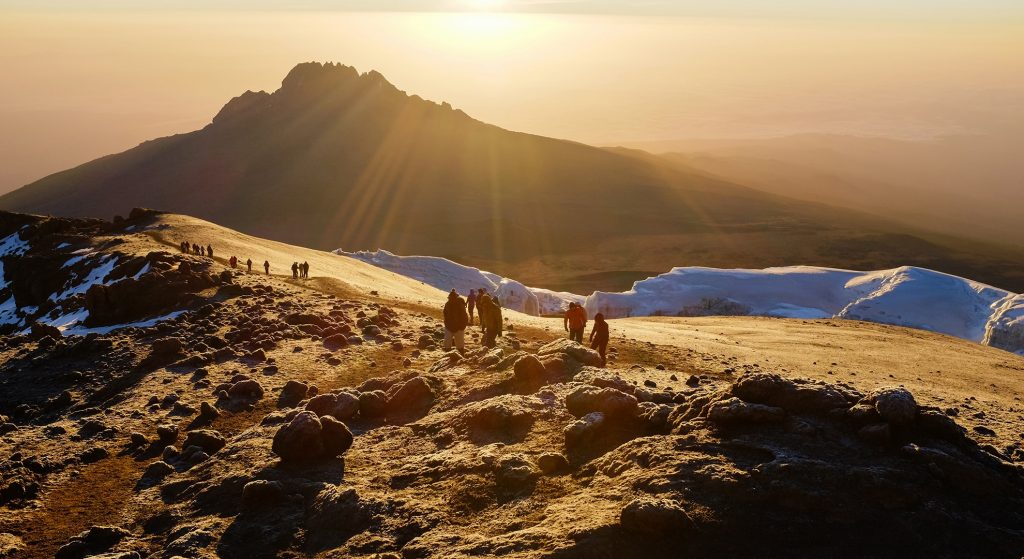
Who It Was Named After
Stella Point was named in honor of Estella (or Stella) Latham, a British climber. In 1925, she became one of the first recorded women to reach this high point during an expedition with her husband, Kingsley Latham. The name pays tribute to her achievement and determination at a time when few women attempted such climbs. Stella Point is a symbolic spot—representing perseverance just before the final reward at Uhuru Peak. If you’re climbing, the sunrise views from here are often unforgettable!
The Rongai route takes 7 days to climb, while the Machame route has two variations: a 6-day climb, which has a lower summit success rate, and a 7-day climb that has an extra acclimatization day, offering a higher summit success rate.
The Lemosho route, on the other hand, takes 8 days to complete. It is one of the routes that we strongly recommend.
The Marangu Route is the shortest route by comparison, as it takes 5 days to complete the climb. The five-day Marangu route is not recommended as it does not give you enough time to acclimatize.
Compare all the Mount Kilimanjaro Routes here.
Here’s a clear breakdown of the typical number of days for the most popular Kilimanjaro routes:
| Route | Standard Duration | Minimum Days | Most Recommended Days | Success Rate Trend | Notes |
|---|---|---|---|---|---|
| Rongai | 6–7 days | 6 | 7 days | Good | Starts on the drier north side, fewer crowds |
| Machame | 6–7 days | 6 | 7 days | Very Good | Scenic “Whiskey Route”, steeper in places |
| Lemosho | 7–8 days | 7 | 8 days | Excellent | Beautiful western approach, excellent acclimatization |
| Marangu | 5–6 days | 5 | 6 days | Lower | Only route with huts (no camping), more crowded |
Quick Recommendations
- Best overall balance — Lemosho 8 days (high success rate + great scenery)
- Best value / popular — Machame 7 days
- Quieter & drier — Rongai 7 days
- Shortest / budget — Marangu 6 days (but lower success rate)
Important Tip:
Adding one extra day (e.g., 7 instead of 6, or 8 instead of 7) significantly improves your acclimatization and summit chances. Most experienced operators (including Tranquil Kilimanjaro) strongly recommend the longer versions.
Lemosho or Northern Circuit Route, which is the best route to choose when trekking Kilimanjaro?
Mount Kilimanjaro routes differ in so many ways. They offer so much variety in terms of days spent, cost, length of the route, traffic, even scenery, and sometimes style of accommodation used on the mountain.
- The shorter routes have low summit success rates, for example, the Marangu route and the Umbwe route, which take about 5 days to complete.
- The popular Machame and Rongai routes take about 6-7 days for each route; they offer longer variations too, and report a better summit success rate.
- The longer routes which also happen to be more scenic are the Lemosho route and newly introduced Northern Circuit routes which take a considerably long duration of 8 or 9 days respectively.
Where the route begins from is also not the same for each route, Marangu and Umbwe Routes begin from the south heading directly to the summit Rongai begins form the north proceeding to the northern slopes of Kilimanjaro to the summit. The rest of the routes have their starting point set from the western side of the mountain; this side offers amazing vistas and stunning scenery.
For more information and a comparison of all the Mount Kilimanjaro routes, read more.
Here’s a clear comparison of the main Kilimanjaro routes. The key differences are scenery, difficulty, crowds, acclimatization (success rate), and length.
Quick Overview
| Route | Days (Typical) | Success Rate | Scenery | Crowds | Difficulty | Best For |
|---|---|---|---|---|---|---|
| Lemosho | 7–8 | 85–90%+ | Excellent | Moderate | Moderate | Best overall balance |
| Machame | 6–7 | 70–85% | Very good | High | Moderate+ | Scenic, fit hikers |
| Northern Circuit | 8–9 | 90–95%+ | Outstanding | Low | Moderate | Highest success, quiet |
| Rongai | 6–7 | 75–85% | Good | Low | Moderate | Dry side, less crowded |
| Marangu | 5–6 | 50–70% | Good | High | Easier | Budget, huts (no camping) |
| Umbwe | 6 | 60–75% | Dramatic | Very Low | Hardest | Experienced, fast climbers |
Detailed Differences
- Lemosho (7–8 days): Starts on the west side. Long approach through beautiful forest and Shira Plateau. Excellent acclimatization and varied scenery. One of the most popular “premium” routes.
- Machame (6–7 days): Known as the “Whiskey Route.” Steep in places with great views and the dramatic Barranco Wall. Very scenic but busier and more physically demanding.
- Northern Circuit (8–9 days): Loops around the quieter northern side. Best acclimatization and highest success rate. Less crowded, stunning 360° views. Ideal for those wanting the best chance.
- Rongai (6–7 days): Approaches from the drier northeast (Kenyan side). Fewer crowds, good for seeing wildlife early on. Less scenic variety than western routes.
- Marangu (5–6 days): The “Coca-Cola Route.” Easiest and cheapest. Uses simple huts instead of tents. Shorter acclimatization = lower success rate. Very busy.
- Umbwe (6 days): Steepest and most direct. Dramatic but challenging with high exposure. Only for fit, experienced hikers.
Key Factors to Consider
- Success rate — Strongly tied to the number of days (more days = better acclimatization).
- Scenery — Western routes (Lemosho, Machame) are the most beautiful.
- Crowds — Marangu and Machame are busiest; Northern and Rongai are quieter.
- Physical demand — All are non-technical (no ropes), but Machame and Umbwe feel harder due to steeper sections.
- Budget — Marangu is usually the cheapest; longer routes cost more.
Recommendation: For most people, Lemosho (8 days) or Northern Circuit (9 days) offer the best combination of success rate, scenery, and enjoyment. Choose based on your fitness, time, and budget. If you tell me your group size, fitness level, or priorities (e.g., scenery, quiet, budget), I can suggest the best route for you!
Lemosho or Northern Circuit Route, which is the best route to choose when trekking Kilimanjaro?